


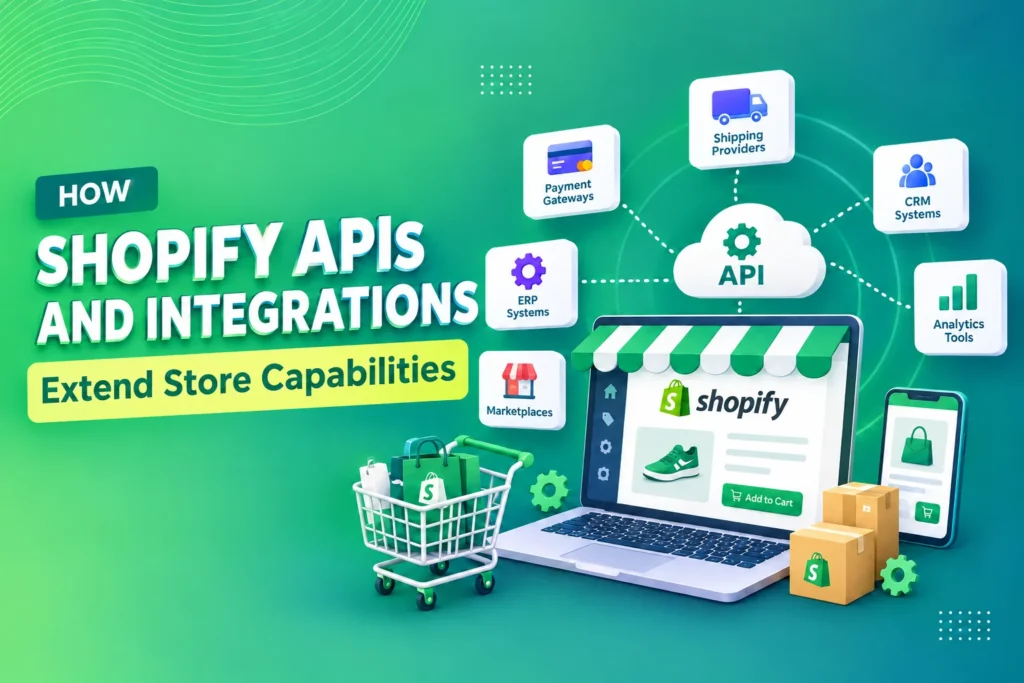
Ecommerce in India has grown at lightning speed. Global markets are also expanding rapidly. Businesses want to offer smart shopping experiences. They aim to make these user experiences more personalized.
Integration is the key pillar of modern business. It connects technology platforms, tools & services into a single ecosystem. Online stores go beyond fundamental functionalities by offering flexible payment gateways, shipping solutions, and advanced marketing automation. Omnichannel sync further adds even more value.
Partnering with a Shopify development company in India helps your brand utilize these benefits. Also, with Shopify development services, your business can gain scalability. All these aspects transition Ecommerce platforms into revenue engines for swift growth.
How Shopify APIs Can Empower Smarter Ecommerce
APIs are connectors. They allow diverse systems to talk to each other. Shopify uses APIs to extend your Ecommerce store’s functionality. They make ecommerce implementation more flexible.
Key Shopify APIs for Ecommerce Integrations
Shopify provides powerful APIs. They allow applications to interact with Ecommerce store data sets. These APIs enhance storefront experiences along with precise customer journeys.
They enable developers to build custom solutions, automate workflows & extend ecommerce functionality. They do this across backend operations and customer-facing experiences.
#1. GraphQL Admin API
Purpose: Store management.
The GraphQL Admin API offers businesses control over products, customer orders & inventory. It backs efficient queries and reduces data transfer. They also allow developers to enable store operations programmatically.
Examples:
- Automating product catalog updates.
- Syncing customer data with CRM systems.
- Managing order fulfillment & inventory.
#2. Storefront API
Purpose: Customer-facing experiences.
The Storefront API powers personalized shopping journeys. It enables developers to build custom storefronts and mobile apps. It also facilitates headless commerce solutions while blending with Shopify’s backend.
Examples:
- Creating exclusive front-end designs.
- Building shopping applications.
- Supporting omnichannel selling.
#3. Checkout & Customer Experience APIs:
Purpose: Enhance buying journeys.
Shopify offers modern tools for extending checkout and customer experiences. The legacy REST Checkout API is deprecated. However, developers can use Checkout Extensibility. They can also utilize Customer Account APIs to personalize the buying journey.
Examples:
- Adding custom fields or upsell offers at checkout.
- Integrating loyalty programs or payment gateways.
- Enhancing customer account portals with personalized features.
Shopify APIs Overview
| API Type | Shopify APIs Overview | Key Benefits | Use Cases |
| GraphQL Admin API | Backend management API for products, orders, inventory & customer records. | Efficient queries, control over products & orders. | Product catalog automation, CRM sync & inventory management. |
| Storefront API | Enables the API powering personalized shopping journeys & headless commerce. | Custom storefronts & headless commerce support. | Personalized shopping flows, mobile apps & omnichannel selling. |
| Checkout & Customer Experience APIs | Modern extensibility tools for customizing checkout and improving customer accounts. | Loyalty & payment integration with flexible checkout. | Checkout customization, upsells & enabling customer account portals. |
Turning APIs into Profits with Expert Shopify Partners
A Shopify ecommerce development company can offer you this potential. With Shopify services, businesses can customize technology solutions. And tailor them to their business needs.
They can build apps, automate workflows & optimize performance. So, APIs make Ecommerce smarter. And skilled partners make them profitable.
What are the Key Integrations That Transform Ecommerce?
Integrations are the hidden drivers of modern ecommerce. They connect essential tools directly into your online store.
Shopify APIs unify these connections, powering payments, shipping, CRM & marketing automation with ease.
-
Seamless Payment Gateway Integrations
Payment gateways are the lifeline of an ecommerce business. They ensure that transactions are secure & convenient for customers.
Shopify APIs connect these gateways directly into the store. This helps reduce friction at checkout. Whether it’s credit cards, UPI, or wallets, integrations make payments reliable.
-
Smart Connections with Shipping & CRM Tools
Both shipping-driven providers & CRM-based tools are vital. APIs allow stores to link shipping partners for real‑time tracking updates.
CRM systems help in managing customer data. They automate communication & strengthen loyalty programs. Together, these integrations build a well-connected ecosystem. This improves customer satisfaction.
-
Localized Engagement
Marketing automation drives growth by streamlining digital campaigns. WhatsApp notifications steer localized integrations. Shopify APIs further enable this by sending instant order updates. They also allow promotions to easily reach out to customers.
A Shopify development agency ensures these integrations are well-optimized. With expert Shopify development services, businesses can easily automate workflows. They reduce friction & deliver a truly connected shopping experience.
How to Enable Advanced Customizations Through APIs?
Shopify APIs empower businesses to tailor ecommerce experiences. They facilitate personalization & multi‑channel selling. They also drive business growth through their development services..
-
Personalized Shopping Experiences
Shopify APIs allow businesses to deliver personalized shopping journeys. Stores can be integrated with product recommendation engines. They can recommend products grounded on browsing history.
Loyalty programs can be built into the store. They acknowledge customers with discounts & offers. These features make customers feel valued. They also encourage repeat product purchases.
-
Multi-Channel Selling Made Simple
APIs enable seamless connections. They facilitate marketplaces, commerce platforms & apps. This ensures that all items stay steady.
So, customers enjoy a unified experience whether they shop on a – website, Instagram, or Amazon. Thus, multi‑channel selling is powered by APIs. It helps brands expand their reachability. They can capture a diverse range of audiences.
Shopify vs WooCommerce Integrations
Shopify offers an API‑driven environment. WooCommerce, on the other hand, is open‑source & plugin‑based. It offers developers more control. However, it requires highly effective management.
Businesses choose Shopify when they require modern-day & advanced integrations. On the other hand, WooCommerce development services in India are ideal for cost‑effective technology solutions.
|
Aspects |
Shopify (Hosted & API-Driven) |
WooCommerce (Open-Source & Plugin-Based) |
|---|---|---|
| Scalability | Built-in hosting. APIs make scaling seamless. | Flexible. Requires manual server scaling. Need plugin management. |
| Cost | Subscription fees; predictable but higher in the long term. | Lower upfront. Variable costs for hosting, plugins & maintenance. |
| Integration | APIs allow smooth & safe connections. | Moderate. Depends on plugins & may need developer support. |
Why Work with a Shopify Ecommerce Development Company?
A Shopify development agency doesn’t merely build stores. It extends capabilities. Expert partners handle APIs well. They also enable integrations with complete precision.
They provide ongoing support and optimization. Alos, they ensure your Ecommerce platform remains compliant.
-
Expertise in APIs & Compliance
With deep expertise, Shopify development company in India can handle coplex integrations efficiently. They ensure integrations are secure. They also take care of compliance with industry benchmarks.
This expertise reduces business risks. It also guarantees smooth functionality across your ecommerce ecosystem.
-
Structured Integrations for Growth
Partners design integrations that connect payment gateways, CRMs & marketing platforms. Structured workflows eliminate friction. These integrations help businesses scale faster. They also sustain consistency across diverse channels.
-
Ongoing Support
Beyond the initial setup, an expert team also provides ongoing monitoring. They optimize performance levels. They even adapt to evolving market needs. This ongoing support ensures your Ecommerce store, stays highly competitive.
Moving Forward
The future of ecommerce lies in smarter & more connected ecosystems. AI‑driven personalization will deliver intelligent shopping experiences. And headless commerce will separate front‑end design from back-end systems for added flexibility.
API‑first ecosystems are becoming the standard. This will ensure effortless integrations across platforms. Shopify design & development services prepare businesses for these trends.
At the same time, WooCommerce development services in India are evolving the plugin ecosystem. They offer flexibility for brands seeking cost‑effective customization. Together, these innovations point toward a future in which – integrations will drive business.
FAQs
- What does a modern Shopify development company offer?
A Shopify development company delivers all-inclusive ecommerce solutions. They offer theme customization, app development & API integrations. They also blend cost‑efficient development services with all quality benchmarks.
- How do WooCommerce development services compare to Shopify?
WooCommerce development focuses on – open‑source flexibility, plugin customization & WordPress integration. They are ideal for all types of SMEs. However, Shopify well suits companies that seek API‑driven scalability.
- Which Shopify development services are critical for future-ready Ecommerce?
Key services include headless commerce implementation & AI‑driven personalization. These services prepare businesses for API‑first ecosystems. They ensure business adaptability to new Ecommerce platforms. And they must also meet all customer expectations.
- How do Shopify APIs & integrations extend capabilities beyond basics?
They both enable businesses with advanced personalization & multi‑channel selling. For example, blending a WhatsApp notification feature enhances a business’s engagement levels. With expert partners, APIs transform Ecommerce businesses into profitable ecosystems.
- How does a Shopify development company ensure compliance with global standards?
They implement secure payment gateways, GDPR‑ready data handling & PCI‑DSS compliance. This ensures international customers can shop confidently. And Ecommerce businesses avoid regulatory risks.