


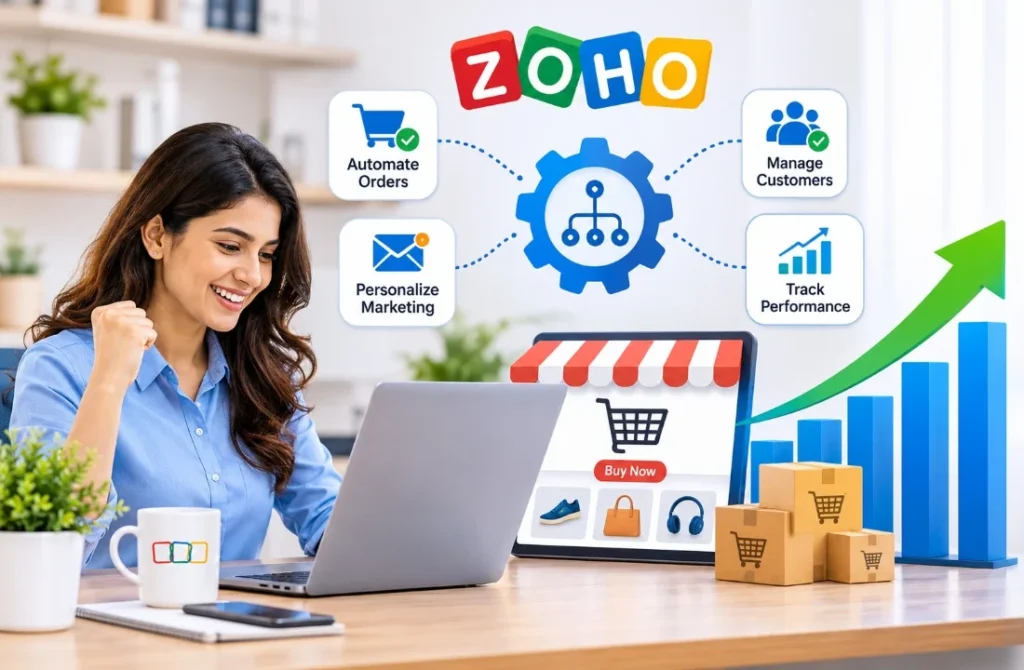
A lot of tasks are carried out by e-commerce businesses every day, such as placing orders, managing inventory, communicating with customers, tracking payments, and marketing. As the online store expands, it is hard to manage these activities manually. These factors can impact customer satisfaction and business performance due to delayed order processing, poor inventory management, and failure to follow up with customers.
These activities can be streamlined and become more efficient in businesses with automation, especially when the workload is growing. Zoho for E-Commerce Businesses offers applications that integrate the sales, inventory, customer management, accounting, and marketing processes into a single business ecosystem.
By implementing the proper Zoho automation strategy, e-commerce businesses can streamline repetitive tasks, boost accuracy in operations, and enhance customer experience. Let’s take a look at how Zoho automation can help your online businesses grow faster.
Why E-commerce Businesses Need Automation to Grow
It’s not just about listing products and taking orders – running an online store also means managing a growing business. It’s not only about listing products and getting orders – running an online store also means building a growing business. From inventory and shipping and customer service and payments to marketing and more, businesses need to coordinate.
With these processes relying on manual labour, several issues can arise:
- Delays in order management: Processing numerous orders manually can lead to order errors and late deliveries.
- Stock inconsistencies: Stock data might not be updated on the same day following an order.
- Failure to communicate with customers: Companies might not receive any order updates, enquiries, or follow-ups.
- Repeated data entry: Staff members waste time on tedious administrative tasks, such as data entry, invoicing, and record-keeping.
- Poor visibility in business: Disconnected systems make it challenging to know what’s going on with sales and customer activity.
These are solved by automation by bringing business apps together and eliminating needless manual tasks.
How Zoho Automation Helps E-commerce Businesses Grow Faster
Zoho has a variety of business applications that enable e-commerce entrepreneurs to automate daily tasks. Applications can be picked depending on the needs of a business and integrated to allow for efficient workflows.
1. Automates Order Processing and Management
Order processing is one of the most critical functions in e-commerce. As orders surge, it’s easy to make errors and delays when handling each order individually. Businesses can organize order-related information in Zoho applications and automate various order processing activities. An example of this is when a customer places an order on an online store, an integrated workflow will collect order information, update relevant records, and alert the fulfillment team.
Businesses can automate activities such as:
- Obtaining details of the customer’s order.
- Automatically updating order records.
- Notifying about orders placed.
- Monitoring the status of orders.
- Creating invoices from orders.
These automated processes decrease repetitive work and benefit the team in order processing. This means businesses can handle large volumes of orders without the need to add extra administrative tasks.
2. Improves Inventory Management
Managing inventory becomes more complicated when a business has multiple online marketplaces and/or sales channels. In the absence of correct stock data, businesses could end up overselling, run into unexpected shortages, or be forced to wait for the goods to arrive. Zoho Inventory is a solution that assists businesses in keeping track of their stock levels, sales orders, purchase orders, and warehouse operations.
Through an appropriate integration and automation workflow, businesses can:
- Re-Enter stock once orders are placed.
- Check the supply of products.
- Receive low-stock notifications.
- Monitor stocks in various warehouses.
- Manage purchase orders and supplier information.
- Track the movement and the performance of products.
When the stock level of a product reaches a pre-defined level, the system can send a notification to the purchasing team, for instance. This enables staff to make planning arrangements before products aren’t available.
3. Strengthens Customer Relationship Management
Repeat purchases and business growth are directly dependent upon the customer relationship. But it is difficult to handle the inquiries, purchase history, and follow-ups manually if the customer base grows.
With Zoho CRM, e-commerce companies can easily keep track of customer data and communicate with customers throughout the customer journey.
- CRM automation can help businesses:
- Gather enquiries through website forms.
- Maintain centralised records of customer information.
- Assign follow-up activities to sales representatives.
- Make automated follow-up reminders.
- Monitor customer activity and shopping history.
- Identify opportunities for repeat sales.
For instance, if a customer contacts an online store via the contact form, Zoho CRM can create a customer record and set up a follow-up task automatically.
4. Streamlines Marketing and Sales Activities
While it is essential to attract new people to their website, it is just as valuable to have existing customers remain with them. Marketing automation enables a company to send out the most relevant messages at the right time to its customers. Zoho Campaigns will help manage email marketing campaigns, and Zoho CRM will help manage customer interactions and information.
Various marketing activities can be automated, such as:
- Sharing promotional email messages.
- Grouping customers according to their interests.
- Sharing product announcements.
- Sending personalized offers.
- After purchasing, follow up with customers.
- Monitoring email engagement and campaign results.
For instance, an eCommerce fashion business can segment users according to their past purchases and ship correct product suggestions or seasonal promotions.
5. Simplifies Invoicing and Payment Tracking
Manual processing of invoices and payments can often lead to extra administrative burden, particularly for businesses in e-commerce, which handle many hundreds of payments. Zoho Books is an accounting software that supports businesses in managing accounting, invoicing, expenses, and financial records.
Automating workflows can streamline the financial functions of businesses when integrated with the right system.
- Typical automation applications include:
- Creating an invoice from a sale.
- Recording customer transactions.
- Tracking outstanding payments.
- Sending payment reminders.
- Organizing financial records.
- Monitoring business expenses.
Once an order is placed, for instance, an integrated workflow can take the details from that order and create and send out an invoice to the corresponding team.
Key Zoho Applications for E-commerce Business Automation
Different Zoho applications support different areas of e-commerce operations. Businesses can combine them to create an automation system based on their workflows.
| Zoho Application | Primary Purpose |
| Zoho CRM | Customer relationship and sales management |
| Zoho Inventory | Inventory and order management |
| Zoho Books | Accounting and invoicing |
| Zoho Campaigns | Email marketing automation |
| Zoho Analytics | Business reporting and analytics |
| Zoho Flow | Application integration and workflow automation |
Selecting the right combination depends on business size, sales channels, operational requirements, and existing software systems.
Real-World Examples of Zoho Automation in E-commerce
Seeing how to apply it makes it easier to understand how automation can enhance daily business operations.
Automated Order-to-Fulfillment Workflow
By integrating the automation workflow, order data can be collected, product stock can be updated, the relevant invoices can be created, and the fulfillment team can be informed of the orders. The updated order information can then be used by the employees to process shipments.
Automated Customer Follow-Ups
For an online retailer, CRM and marketing automation can help them stay in touch with their customers. For example, after a purchase, customers can receive order-related updates. Also, businesses can set up follow-up emails to ask for feedback or share pertinent product recommendations.
Automated Inventory Alerts
Assume that an online store has hundreds of items. It can be difficult to keep up with the inventory of each product. Automated inventory notifications allow the purchasing team to be alerted when a certain set of products are running low on stock.
This assists organisations in making plans for replenishment and minimising the risk of selling out products.
Benefits of Implementing Zoho Automation for E-commerce Businesses
Implementing the right automation workflows can improve areas of business operations.
- Increased efficiency: Automation reduces repetitive tasks and allows employees to focus on important business activities.
- Reduced manual errors: Automated data updates help minimize mistakes associated with information entry.
- Inventory accuracy: Connected inventory processes improve stock visibility and help prevent overselling.
- Customer experience: Faster responses, personalized communication, and timely order updates improve customer interactions.
- Order fulfillment: Streamlined order processing helps teams manage purchases and deliveries more efficiently.
- Business decisions: Zoho Analytics helps businesses analyze sales trends, customer behavior, and operational performance.
Why Choose Vision Infotech for Zoho E-commerce Automation?
Every e‑commerce business has its operational needs. A growing online retailer might need inventory control. A large e‑commerce company might need connections between many platforms and business applications.
Vision Infotech offers Zoho development, consulting, and integration services to help businesses improve their operations with solutions.
- Our services can help e‑commerce businesses with:
- Zoho CRM implementation and customization.
- Zoho Inventory setup. Configuration.
- E‑commerce platform and third‑party application integration.
- Automated. Inventory workflows.
- Customer management and marketing automation.
- API‑based. Custom business workflows.
With the implementation plan, e‑commerce businesses can connect their applications, cut down on manual work, and see their operations better.
Conclusion
E-commerce growth needs order processing, accurate inventory management, strong customer relationships, and well-organised financial operations. Managing these activities manually becomes harder and harder as businesses grow.
Zoho automation helps simplify operations by linking different business applications and reducing repetitive tasks. From order management and inventory tracking to customer communication and financial reporting, Zoho automation lets businesses create efficient workflows.
By implementing the Zoho solutions, for E-commerce Businesses online retailers can boost productivity deliver better customer experiences and build scalable operations.
If you want to simplify your e-commerce workflows and improve business efficiency, Vision Infotech can help you implement Zoho automation solutions based on your requirements.