


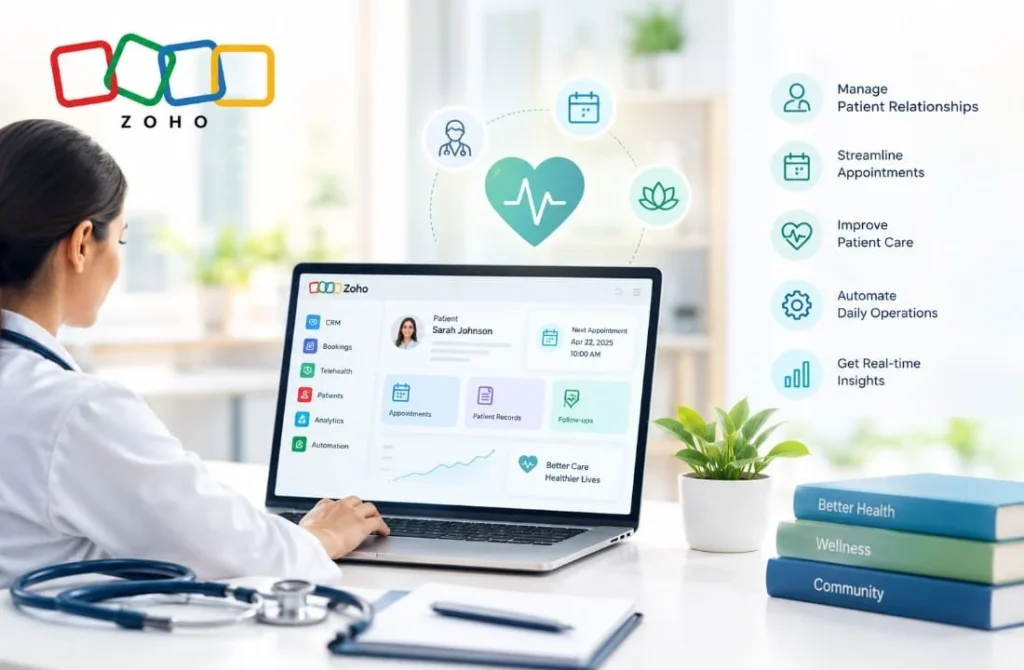
Healthcare and wellness companies don’t just handle visits and interactions with patients. Administrative tasks, communication, billing, documentation, scheduling, and reporting are behind every consultation, treatment, follow-up, and wellness program. If these activities are performed using isolated tools, teams will waste a lot of time transferring data to another system rather than working with patients and business operations.
There are many processes that modern business software can assist healthcare and wellness businesses in incorporating. Zoho provides applications and healthcare solutions that can help with patient relationship management, scheduling, communication, reporting, documentation, and more.
The trick with any organization that is looking into Zoho for Healthcare and Wellness is the fact that they’re not just taking another software system. It’s knowing which business processes can be streamlined, automated, and integrated for a seamless user experience.
Why Healthcare and Wellness Businesses Need Better Operations Management
Healthcare organizations have to work with several teams, processes, and communication channels. A clinic could have to plan and schedule patient visits, answer patient questions, schedule follow-up visits, manage staff schedules, payments, marketing, and reporting. A health business can also provide membership management, consultations, repeat services, customer communications, and promotional campaigns. With information spread out over spreadsheets, email, messaging systems, and different applications, it’s tougher to keep a common sense of interactions with customers or patients.
Technology can play a role in helping to meet this need by centralizing information and developing repeatable processes. Lemony Blog has noted the importance of technologies, reporting systems, collaboration, and patient engagement in improving healthcare operations in the past.
It isn’t about automating all the human interaction. Rather, companies can automate repetitive administrative tasks, while healthcare professionals are able to concentrate on services that call for human judgment and focus.
How Zoho Supports Healthcare and Wellness Operations
The healthcare CRM solution from Zoho offers features like lead management, appointment scheduling, omnichannel communication, follow-up reminders, reporting, and integration with the healthcare industry’s current systems.
They are beneficial for various kinds of organizations, such as medical centers, clinics, hospitals, wellness centers, and medical practices.
Centralized Patient and Customer Information
Ensuring the consistency of data in various systems is a major operational challenge. Your teams can use a centralized CRM to manage contact data, questions, communication records, referrals, and follow-up to manage their activities. Authorized team members have easy access to relevant information in a common system, eliminating the need to sift through various spreadsheets or emails for information.
Zoho’s healthcare CRM also enables patients to be created and records to be imported from other CRM applications. In the case of wellness businesses, the same level of organization may be provided for customer profiles, a consultation history, service preferences, information about membership, and follow-up activities.
Easier Appointment Management
Another place where automation can help cut down on administrative work is appointment scheduling. Healthcare-oriented Zoho solutions help you with the organization of appointments and include details like department, date, time, priority, rescheduling, and cancellation. Automated reminders and calendar integrations can also help businesses improve coordination between their employees and customers.
For example, a wellness center could create workflows for:
- Appointment confirmations
- Reminder messages
- Rescheduling requests
- Follow-up communications
- Consultation notifications
These processes can minimize repetitive back-and-forth manual communication and provide staff with a greater level of visibility into upcoming activity.
Better Patient and Customer Communication
Healthcare & wellness companies can reach out to customers via a variety of channels including email, phone, messaging applications, and websites.
When these interactions are disjointed, it can be challenging to gain a full view of the customer journey. Zoho’s healthcare CRM is defined by the ability to offer omnichannel communication, such as email, SMS, WhatsApp, and chatbots for specific communication workflows.
An automated sequence, for instance, might describe how a new inquiry is picked up, passed on to the right team member, followed up by phone, email, or some other chosen communication channel, and then tracked within the CRM.
Automation is not for the purpose of replacing personal communication. Alternatively, it can help ensure that regular messages are delivered on a consistent basis, while employees are still able to engage in discussions that need their individual attention.
Automating Repetitive Administrative Tasks
Healthcare and wellness organizations can have a lot of administrative tasks. For repetitive tasks, automation can enable businesses to establish predetermined workflows. For instance, if the query is new, a workflow could then assign the query to a team member, create a follow-up task, and send a relevant confirmation message.
Examples of other possible workflows are:
- New inquiry assignment
- Appointment reminders
- Follow-up task creation
- Customer onboarding
- Internal notifications
- Document approval
- Feedback collection
- Lead status updates
The exact workflow may vary depending on the organization’s processes, personnel, and adherence needs. The goal is to ensure that routine work becomes predictable, but continues to be supervised by humans.
Using Reports to Understand Business Performance
Healthcare and wellness businesses can use dashboards and reports to monitor operational metrics such as inquiries, appointments, conversions, visits, follow-ups, and revenue-related information. Zoho’s healthcare CRM describes customizable dashboards and reporting capabilities for analyzing metrics and clinic or hospital performance.
For example, management could use reports to identify:
- Sources generating the most inquiries
- Appointment trends
- Follow-up activity
- No-show patterns
- Service demand
- Customer engagement
- Revenue-related trends
These insights can help management identify where operational processes need improvement.
Security and Compliance Should Come First
It is important to bear in mind the privacy and security implications of all technology choices, as healthcare organizations have to deal with sensitive information. Zoho One and Zoho CRM are two examples of Zoho’s products that feature features related to HIPAA. For instance, Zoho CRM has controls to help you identify personal health information and limit access or export of specific information.
But having a software product does not necessarily make an organization HIPAA compliant. Compliance relies upon the organization’s configuration, the way it’s handling information, who is given access, the policies it is implementing, and its legal and regulatory responsibilities. Covered entities and business associates may require a Business Associate Agreement, Zoho says.
Key Benefits of Zoho for Healthcare and Wellness
Zoho has a lot of benefits for the healthcare and wellness industry. Zoho offers a number of benefits for the healthcare and wellness sector.
1. Healthcare CRM
Zoho CRM is a tool that can help healthcare and wellness organizations manage patient and client data, such as contact details, visit history, notes, and interactions. Centralized information simplifies the way relevant information is accessed by authorized teams and makes managing relationships easy.
2. Data Security
Ensuring that sensitive healthcare information is protected is of the utmost priority. Security and compliance options are available in Zoho that can help organizations better control and maintain access to sensitive information, ensure that data is stored securely, and enhance control over data access and handling.
3. Billing and Payments
Businesses can automate their billing with Zoho’s invoice, receipt, and payment tracking and reminder features. Implementing payment solutions can also further automate transactions, eliminate manual follow-ups, and offer customers a more convenient payment experience.
4. Telehealth Solutions
Telehealth capabilities can assist health and wellbeing providers in reaching patients from a distance. The use of secure virtual consultations enables organizations to reach people who may not be able to access a physical location, which helps to accommodate flexible and accessible service delivery.
5. EMR Integration
The integration with existing EMR or healthcare systems can minimize repetitive data entry and enhance the flow of data between applications. This can help minimize manual errors while allowing staff to spend more time on patient and business activities.
6. Reporting and Analytics
Zoho reporting and analytics tools can offer operational trend dashboards and insights into appointments, customer interactions, and business performance. These insights allow healthcare and wellness organizations to recognize trends and make informed decisions about their operations.
Choosing the Right Technology Partner
Of course, the software is just a component of an effective digital transformation. Customization and integrations, workflow design, data migration, automation, and technical support can also be critical areas for healthcare and wellness businesses.
When organisations are considering Zoho for Healthcare and Wellness, they can reach out to a tried and trusted Zoho technology partner to connect the dots between their existing workflows and the right applications, to develop an appropriate workflow around their business needs.
For those enterprises that require a tailored implementation, integration, and/or automation of Zoho, Vision Infotech offers Zoho implementation, consulting, and development services, which are built around specific business processes. The right way to implement always starts with the business requirements and not in the name of modernisation.
Conclusion
Healthcare and wellness businesses need operations. Healthcare and wellness businesses also need communication, organized data, and dependable reporting. A connected technology ecosystem can help reduce work while giving teams better visibility into their daily activities.
Zoho offers tools for CRM, appointment scheduling, communication, automation, reporting, system integrations, and document management, along with solutions designed for healthcare organizations.
The key is to implement technology. Healthcare and wellness businesses should first understand their challenges, select the right tools, protect sensitive information, train employees, and continuously improve their processes. Working with a Zoho CRM consultancy can also help organizations configure CRM workflows, integrations, and automation according to their specific operational requirements.