


The Python programming concepts every data science beginner must know fit on one page, yet most learners spend months on topics they never use at work. If you are a fresher, a career switcher or an IT professional eyeing a data role in Bengaluru, Hyderabad or Pune, focus beats volume.
In this guide, you will learn the exact Python basics that show up in real data work. You will also see worked examples, the mistakes that waste beginners’ time, and an 8-week plan to practise Python for data science.
Quick answer: The Python programming concepts every data science beginner must know are variables and data types, Python data structures (lists, tuples, dictionaries, sets), loops and conditions, functions, list comprehensions, error handling, and the pandas and NumPy libraries. Master these, and you can load, clean, analyse and chart most real datasets.

Why is Python the first language for data science?
Python is the first language for data science because it reads almost like English and has the richest set of data libraries. That is why the Python programming concepts every data science beginner must know are also the ones hiring managers test first.
The numbers show why the Python programming concepts every data science beginner must know are worth your time. Python holds the No. 1 spot in the November 2026 TIOBE Index with a 20.86% rating. It also leads the November 2026 PYPL Index with 52.04% of programming tutorial searches, so more learners study Python than any other language.
Indian employers expect the Python programming concepts every data science beginner must know too. By January 2026, 14% of job postings in India mentioned AI, up from 8.9% a year earlier, according to the Nasscom–Indeed AI talent report. Most of those AI and data roles list Python for data science as a core skill.
Which Python basics should you learn first?
Start with variables and data types, because every dataset you touch is built from them. A variable is a name that points to a value, such as salary = 650000. Get these Python basics right, and everything else in the Python programming concepts every data science beginner must know becomes easier.
The Python programming concepts every data science beginner must know start with four everyday data types:
- int: whole numbers, such as 42 orders.
- float: decimal numbers, such as 4.75 average rating.
- str: text, such as “Hyderabad”.
- bool: True or False, such as is_active = True.
Mixed types cause a common bug when you apply the Python programming concepts every data science beginner must know to real files. If a CSV column holds “650000” as text, adding it to a number throws a TypeError. Convert it first with int(“650000”), and check any value’s type with the type() function.
What are Python data structures?
Python data structures are containers that hold many values in one variable. Four of them cover nearly all data science work, so they belong on any list of Python programming concepts every data science beginner must know.
- List: an ordered, changeable collection, such as cities = [“Pune”, “Bengaluru”, “Hyderabad”].
- Tuple: an ordered collection you cannot change, such as a fixed (latitude, longitude) pair.
- Dictionary: key-value pairs, such as {“name”: “Asha”, “city”: “Pune”}, which mirror one row of data.
- Set: unique values only, which makes removing duplicate customer IDs instant.

A quick rule helps you apply the Python programming concepts every data science beginner must know to real data. Use a list for ordered items, a dictionary for labelled fields, a set for uniqueness, and a tuple for values that must not change.
How do loops, conditions and functions help you clean data?
Loops, conditions and functions let you repeat a cleaning step on thousands of rows without copying code. These three ideas sit at the centre of the Python programming concepts every data science beginner must know.
Each of the Python programming concepts every data science beginner must know has a simple definition. A loop is a block that repeats for each item, such as for city in cities.
A condition is an if statement that runs code only when a test is true. A function is a named, reusable block that takes inputs and returns an output.
Here is how the Python programming concepts every data science beginner must know work on a typical HR dataset. Suppose salary values arrive as text like “₹6,50,000” and “650000 INR”. You can write one function, clean_salary, that removes the ₹ sign, commas and “INR”, then returns an int. Call it inside a loop, and every row comes out clean.
What is a list comprehension?
A list comprehension is a one-line way to build a new list from an old one. For example, [s * 1.1 for s in salaries] gives every salary a 10% raise. This shortcut is one of the Python programming concepts every data science beginner must know, because it is shorter and usually faster than a full loop.
What is error handling with try and except?
Error handling is code that catches a failure and keeps the program running. Wrap risky steps in try and except ValueError, and one bad row no longer crashes a script processing 2 lakh records. Logging bad rows is one of the Python programming concepts every data science beginner must know, because it shows you what to fix later.
How do pandas and NumPy fit into Python for data science?
Pandas and NumPy are the two libraries that turn plain Python into a data analysis tool. Learning pandas and NumPy completes the Python programming concepts every data science beginner must know.
What is a NumPy array?
A NumPy array is a grid of numbers of one type that supports fast maths on every value at once. Multiplying an array of 1 million prices by 1.18 to add GST takes a single line. Vectorised maths is one of the Python programming concepts every data science beginner must know, since a plain loop runs far slower.
What is a pandas DataFrame?
A pandas DataFrame is a table with labelled rows and columns, like an Excel sheet inside Python. You load a file with pd.read_csv(“sales.csv”), inspect it with df.head() and df.info(), and summarise it with df.describe().

Three pandas operations put the Python programming concepts every data science beginner must know into practice:
- Filter rows: df[df[“city”] == “Pune”] keeps only Pune orders.
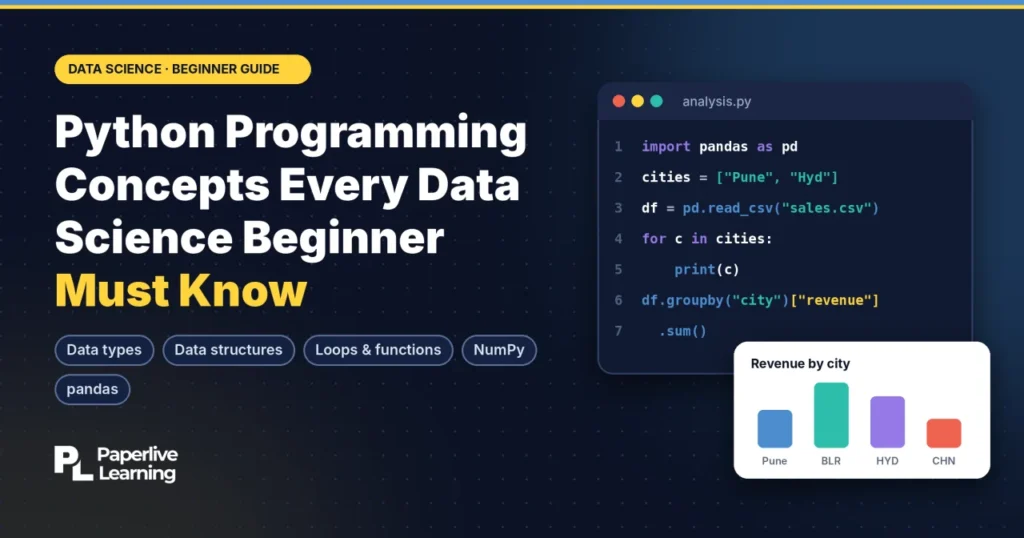
- Group and summarise: df.groupby(“city”)[“revenue”].sum() totals revenue by city.
- Handle missing values: df.isna().sum() counts gaps, and fillna() fills them.
Other Python libraries for data science build on these two. Matplotlib and Seaborn draw charts, and scikit-learn trains machine learning models.
Want to practise these Python libraries for data science on real datasets with a mentor reviewing your work? Enrol in PaperLive’s online Data Science course, which offers hands-on training with real-time projects.
What mistakes do beginners make with Python for data science?
Most beginner mistakes come from writing Python like a spreadsheet instead of like code. Knowing them early is part of the Python programming concepts every data science beginner must know.
- Looping over DataFrame rows: iterrows() on 5 lakh rows can take minutes. Use vectorised column maths instead, which runs in seconds.
- Chained indexing: df[df[“age”] > 30][“band”] = “senior” triggers SettingWithCopyWarning and may not save. Use df.loc[df[“age”] > 30, “band”] = “senior”.
- Confusing == and is: == compares values, while is checks whether two names point to the same object. Use == for data comparisons.
- Editing a list while looping over it: removing items mid-loop silently skips values. Build a new list with a comprehension instead.
- Skipping virtual environments: installing every package globally breaks projects later. Create one environment per project with venv or Conda.
Readable code is one of the Python programming concepts every data science beginner must know. As PEP 8, the official Python style guide co-authored by Python creator Guido van Rossum, says, “code is read much more often than it is written”. PEP 8 on the Python website is worth reading once you finish the Python basics.
How should you practise these Python concepts in 8 weeks?
You can learn the Python programming concepts every data science beginner must know in about 8 weeks with one hour of daily practice. Follow these steps in order, and the Python programming concepts every data science beginner must know will stick.
- Week 1: install Anaconda or use Google Colab, then practise variables, data types and print statements.
- Week 2: master Python data structures with 20 small exercises.
- Week 3: write loops, conditions and functions to clean a messy CSV.
- Week 4: learn list comprehensions, error handling and file reading.
- Week 5: study NumPy arrays and vectorised maths.
- Week 6: load, filter and group real data with pandas.
- Week 7: chart your findings with Matplotlib and Seaborn.
- Week 8: finish one Kaggle dataset project and publish it on GitHub.

Pick tools that make the Python programming concepts every data science beginner must know easy to practise. Jupyter Notebook and Google Colab suit exploring data, while VS Code suits longer scripts. Basic command-line comfort also helps, so our Linux skills guide is a useful side read.
Which data roles in India need these Python skills?
Data analyst, data scientist, machine learning engineer and business analyst roles in India all test the Python programming concepts every data science beginner must know. Interviews at service firms and startups alike start with Python data structures and pandas questions.
Freshers usually enter as data analysts, where the Python programming concepts every data science beginner must know meet SQL and charts every day. With 2 to 3 years of experience, many move into data scientist roles that add statistics and machine learning.
Cloud skills help too, since most data now lives on AWS, Azure or Google Cloud, as our cloud computing models guide explains.

Non-IT graduates learn the Python programming concepts every data science beginner must know too. If you come from commerce, mechanical or another field, our guide for non-IT professionals moving into tech shows how others planned the move.
Frequently asked questions
How long does it take to learn Python for data science?
Most beginners learn the Python programming concepts every data science beginner must know in 8 to 12 weeks with an hour of daily practice. Job-ready skill usually takes 4 to 6 months, including projects.
Do I need maths to learn the Python basics?
No, school-level maths is enough for the Python basics. Statistics comes later, once the Python programming concepts every data science beginner must know feel natural.
Should I learn pandas and NumPy before machine learning?
Yes. Every machine learning project starts with loading and cleaning data, and pandas and NumPy do that work. Pandas and NumPy are core Python programming concepts every data science beginner must know before scikit-learn.
Can a non-IT graduate learn the Python programming concepts every data science beginner must know?
Yes, many commerce and mechanical graduates do it every year. Start with variables and lists, practise daily, and build small projects with real Indian datasets.
Is Python enough to get a data analyst job?
The Python programming concepts every data science beginner must know are rarely enough alone. Employers also expect SQL, Excel, basic statistics and one charting tool such as Power BI or Tableau.
What should you do next?
You now have a clear map of Python for data science. You have covered variables, Python data structures, loops, functions, error handling, pandas and NumPy, and the mistakes that slow beginners down.
Your next step is to practise the Python programming concepts every data science beginner must know on real projects with feedback. Read what past learners say on our student reviews page. When you are ready, enrol in PaperLive’s online Data Science course, which offers hands-on training with real-time projects.