


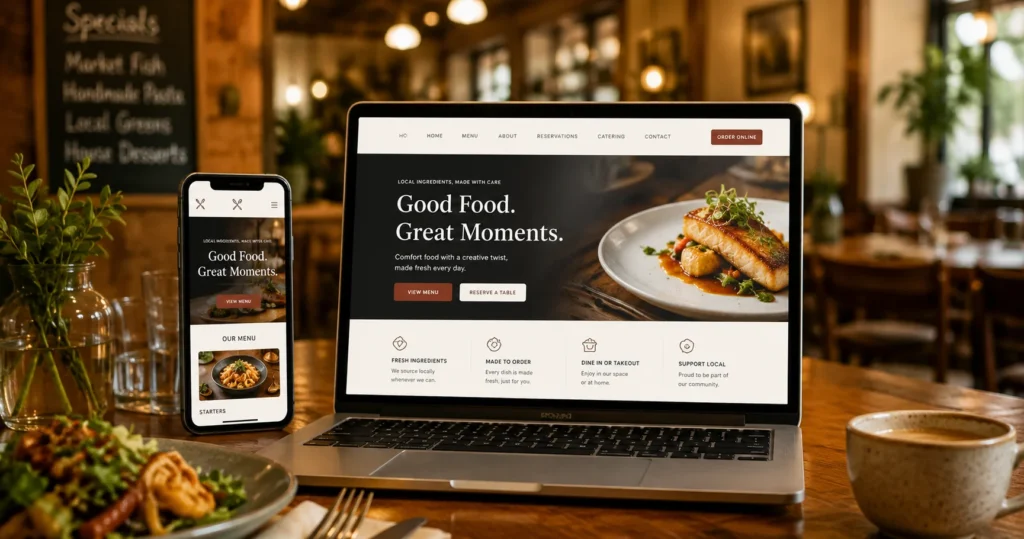
Ask any diner how they choose where to eat tonight, and the answer almost always starts with a phone. They search, they scroll a menu, they check a few photos, and they decide, often in under a minute. If your restaurant’s entire online presence lives on a social media feed, you’re losing a big share of those decisions before the customer ever sees a “Book Now” button.
A well-planned restaurant website design isn’t a vanity project anymore. It’s the single asset that ties together your menu, your reservations, your online orders, and your brand, and it’s one of the few marketing channels you actually own.
The Real Cost of Relying on Delivery Apps Alone
Third-party delivery marketplaces are great for discovery, but they’re expensive for retention. A typical order can lose a large chunk of its value to commission fees, on top of delivery and payment processing costs. That’s money that never touches your bottom line, tied to a customer relationship you never get to own.
Direct ordering through your own website flips that math. You keep more of every order, you collect the customer’s contact details, and you can bring them back without paying a marketplace a second time. This single shift, from “renting” customers through an app to owning the relationship, is one of the strongest arguments for investing in a proper website.
What Diners Actually Judge Before They Walk In
A few patterns show up again and again in restaurant marketing data:
- A large share of “restaurant near me” searches lead to a same-day visit.
- A meaningful percentage of people won’t visit a restaurant at all if its website looks outdated or broken.
- Most diners check the website before deciding to come in, not after.
- If a site doesn’t load quickly on mobile, more than half of visitors bounce almost immediately.
In other words, your website is doing sales work long before a host ever greets a guest at the door. If it’s slow, cluttered, or missing basic information, you’re quietly turning away business every single day.
Common Mistakes That Quietly Cost Restaurants Money
Even restaurants that have invested in a website often leave revenue on the table because of a few recurring issues:
A PDF Menu Instead of a Real Page
Search engines can’t index a PDF the way they can a proper HTML page, and customers hate pinching and zooming on their phones. A readable, on-page menu helps both search visibility and usability.
No Reservation System on the Website Itself
If guests have to call or jump to a third-party app to book a table, some of them simply won’t bother, and you lose the reservation.
Weak or Missing Food Photography
People decide with their eyes first. Dark, blurry, or generic photos undersell food that might genuinely be excellent.
No Dedicated Catering or Private Events Page
Catering and private events tend to be some of the highest-value bookings a restaurant gets, yet many sites bury this information or leave it out entirely.
Hours, Location, and “Order Online” Buried in the Layout
If a mobile visitor can’t find your hours, address, or ordering link within a few seconds, they’ll move on to a competitor whose site makes it easier.
What a Strong Restaurant Website Design Actually Needs
Beyond fixing the mistakes above, a website built specifically for restaurants, rather than a generic small-business template, tends to include:
- Mobile-first, fast-loading design, since most restaurant traffic comes from phones.
- Direct online ordering integrated with your POS, so orders route straight to the kitchen.
- A built-in reservation system that keeps taking bookings even after the restaurant closes for the night.
- High-value pages for catering, private events, and gift cards, which often generate outsized revenue relative to their traffic.
- On-page SEO and Google Business Profile optimization, so the restaurant actually shows up when people search nearby. Pairing this with an easy way to collect reviews, like a simple QR code on the table, keeps that profile active and trustworthy.
- A consistent visual identity, including logo, color palette, and typography, that carries through from the homepage to the printed menu.
This is where the difference between a template-based site and a purpose-built one becomes obvious. A generic builder can produce something that looks fine, but it rarely accounts for POS integrations, reservation platforms, or the specific pages (catering, events, multi-location menus) that actually drive restaurant revenue.
Choosing Between a General Website Service and a Restaurant-Specific Package
For businesses outside the restaurant industry, a solid website design service that handles layout, user experience, and conversion-focused design is often enough. But restaurants have a narrower, more specific set of needs: POS compatibility, reservation software, delivery integrations, and menu structures that change seasonally.
That’s the gap a dedicated restaurant web design package is built to close. Rather than adapting a general-purpose website template, this kind of package is scoped around what restaurants specifically need to launch with: a brand identity and logo, a mobile-first multi-page website, direct online ordering tied to your POS, reservation integration, an HTML menu with photo support, and dedicated catering and events pages. It’s usually bundled into a fixed price and a short, defined delivery timeline instead of an open-ended project.
For an independent restaurant owner comparing options, that combination of speed, fixed cost, and restaurant-specific functionality is usually more practical than piecing together a generic website and bolting on ordering or reservation tools afterward.
What to Look for Before You Commit
Whichever route you choose, a general web design service or a restaurant-focused package, a few questions are worth asking upfront:
- Does the site work with the POS and reservation system you already use, or will you need to switch?
- Is the design genuinely mobile-first, not just “responsive” as an afterthought?
- Is there support after launch for menu updates, seasonal specials, or small fixes?
- Will your existing Google rankings be protected if you’re rebuilding an older site?
- Is pricing fixed and transparent, or open to scope creep as the project goes on?
Final Thoughts
Good food will always be the foundation of a restaurant’s reputation, but it’s no longer the whole story. Diners decide long before they sit down, and that decision increasingly happens on a phone, on your website, in the space of a few seconds. A thoughtful restaurant website design, with real ordering, real reservations, and real menu pages, doesn’t just look better. It directly protects your margins and brings guests back without paying a delivery app for the privilege.
If your current site is a static brochure, or worse, a PDF menu and a phone number, it’s worth treating the rebuild as an investment with a measurable return, not just a design refresh.
FAQ
Do I really need a website if I’m already active on social media and delivery apps?
Yes. Social media posts disappear from feeds within hours, and delivery apps put you next to every competitor on the same page, often ranked by who pays the highest commission. A website is the one place a customer can see your full menu, book a table, order directly, and get to know your brand without distractions.
Will a new website actually help with reservations and orders, or is it just for looks?
A restaurant website earns its keep when it’s built for function, not just appearance: an HTML menu search engines can read, an integrated reservation system, and direct online ordering tied to your POS. Without those pieces, a good-looking site still won’t move the needle on bookings or orders.
How long does it typically take to launch a restaurant website?
Timelines vary by scope, but a focused, restaurant-specific package can go from kickoff to launch in as little as two weeks, compared to open-ended projects that can stretch for months.
What happens to my current Google rankings if I rebuild my site?
A well-planned rebuild maps your existing pages and sets up redirects before launch, so the search visibility you’ve already built isn’t lost in the switch.
Is a general website design service enough, or do restaurants need something more specific?
A general service can produce a good-looking site, but restaurants typically need POS compatibility, reservation integrations, and dedicated catering and events pages that a general template doesn’t account for. That’s why restaurant-specific packages exist.