


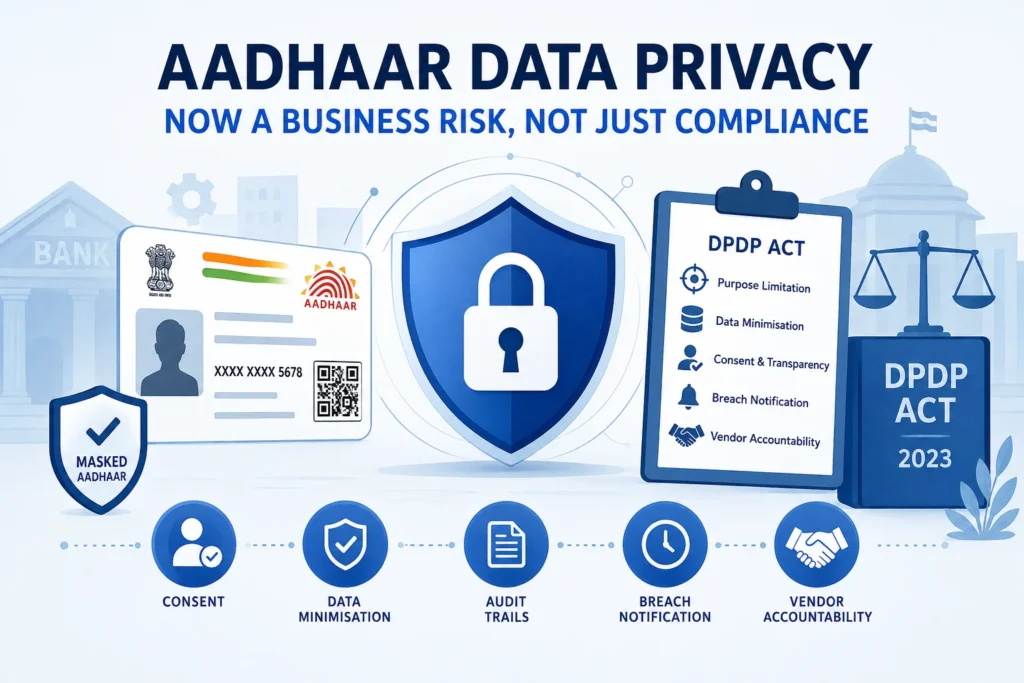
Aadhaar-based KYC has become the fastest, cheapest way for Indian banks, NBFCs, and fintechs to verify a customer’s identity. A few seconds of API calls can now confirm someone’s identity in a way that used to take branch visits and stacks of paperwork. That speed is exactly why regulators are paying closer attention to it. Data privacy around Aadhaar verification is no longer a small print issue handled quietly by a legal team — it now shapes costs, partnerships, and how companies are judged by customers and investors alike.
As more of India’s financial life moves online, the volume of identity data flowing through these systems keeps growing — and that scale is exactly why every organisation touching Aadhaar data now needs to understand what’s expected of it, not just the largest banks.
Two Rulebooks, One Responsibility
Any organisation using Aadhaar verification has to answer to two frameworks at once: the UIDAI’s Aadhaar Act rules, and India’s Digital Personal Data Protection (DPDP) Act, whose detailed Rules were notified in November 2025. Together, they set firm limits on how identity data can be collected, stored, and used. The penalties for ignoring them are significant — the DPDP Act allows for financial penalties running into hundreds of crores for serious violations, on top of the reputational damage that follows any public data mishap.
Before the DPDP Rules, Aadhaar handling was often addressed loosely under general IT and banking regulations. The new Rules change that by spelling out specific, enforceable obligations — timelines, consent formats, reporting duties — rather than leaving them open to interpretation. For any team managing KYC infrastructure, that’s the real shift: vague good practice has been replaced by a checklist regulators can actually audit against.
Why This Matters Beyond the Compliance Team
For any business relying on Aadhaar-based onboarding, this shift shows up in three practical ways:
- It’s an ongoing cost, not a one-time fix. Consent management, breach notification systems, and audit trails require continuous investment, not a single project sign-off.
- It’s a hidden risk factor. A company with weak data-handling practices carries risk that may not appear on a balance sheet until something actually goes wrong.
- It’s becoming a selling point. Companies that can prove they handle Aadhaar data responsibly are winning bank and enterprise partnerships faster, because larger institutions are now checking this closely before signing on.
What the Rules Actually Ask For
A few requirements stand out for anyone building or using Aadhaar-based verification systems:
- Purpose limitation – Data collected for KYC can’t quietly be reused for marketing or other purposes without fresh consent.
- Data minimisation – Storing full Aadhaar numbers is discouraged. Masked Aadhaar or Virtual IDs are the safer, and increasingly required, default.
- Clear consent trails – Consent needs to be specific, recorded, and easy to withdraw — not buried in fine print.
- Breach notification timelines – The DPDP Rules set fixed deadlines for informing both the Data Protection Board and affected individuals after a breach.
- Vendor accountability – If a bank or NBFC outsources KYC checks to a third-party provider, the responsibility doesn’t fully transfer. The regulated entity still answers for how its vendor handles the data.
That last point catches many organisations off guard. Outsourcing the verification process does not outsource the legal responsibility that comes with it. A bank or NBFC partnering with an API-based verification provider is still expected to know how that provider stores and retains data, which is pushing more institutions to demand documentation and audit rights upfront, rather than treating the vendor relationship as a black box.
Questions Worth Asking Before Choosing a KYC Partner
Whether you’re a fintech founder, an NBFC compliance officer, or simply someone evaluating a vendor, three questions help separate genuine compliance from a checkbox exercise:
- Does the system use masked Aadhaar or Virtual IDs by default, instead of storing raw Aadhaar numbers?
- Is there a documented, auditable policy for consent and data retention — or is it handled case by case?
- How much risk does the company carry if one of its own vendors has a data-handling failure?
Organisations that treat these questions as core to how they build their systems, rather than as paperwork, tend to earn trust with banks, insurers, and larger institutional partners more easily.
The Bigger Picture
As enforcement under the DPDP Rules matures through 2026, the gap between organisations with strong data governance and those without it will keep widening — not just in compliance audits, but in who gets chosen as a trusted partner in India’s fast-growing digital identity ecosystem.
For fintech founders and product teams building on Aadhaar verification, the takeaway is simple: treat data privacy as part of the product architecture, not a policy document sitting separately from it. Systems built with masking, consent tracking, and audit logs from day one adapt far more easily to new rules than ones where privacy is bolted on after a regulator asks questions. In a market where trust is the real currency between banks, fintechs, and customers, that head start will matter more with each passing year.
This article is for informational purposes only and does not constitute legal, compliance, or investment advice.