


Search has changed more in the past two years than in the previous decade combined. AI Overviews, AI Mode, and a growing wave of AI-native search tools like ChatGPT and Perplexity have reshaped how people find information and how brands need to show up to be found. Recent industry data puts zero-click search at nearly 60% of all Google queries, with AI-generated answers now resolving the majority of informational searches directly on the results page.
None of this means SEO is dying. It means the definition of “visibility” has expanded well beyond a blue-link ranking. Here are the 10 SEO and AI search trends worth watching and acting on in 2026.
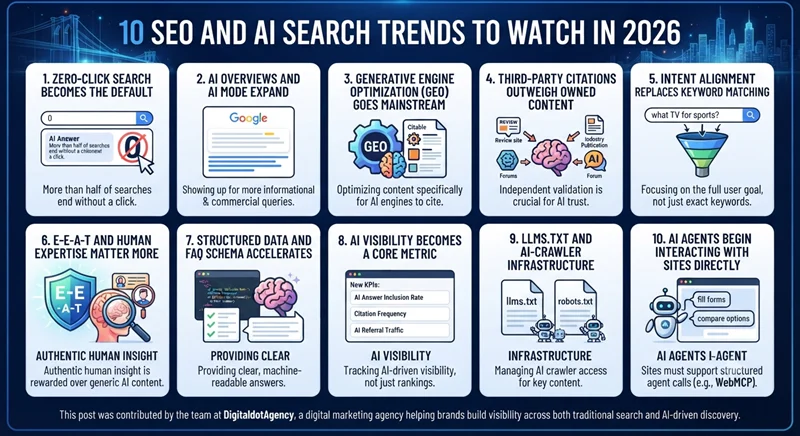
1. Zero-Click Search Becomes the Default, Not the Exception
Search behaviour has crossed a threshold: more than half of Google searches now end without a single click to an external website. AI Overviews accelerate this further, resolving a large share of queries directly on the results page.
For brands, this means ranking #1 no longer guarantees traffic it guarantees eligibility to be seen, not necessarily clicked. Success in 2026 depends on being cited, quoted, and referenced inside the answer itself, not just linked below it.
2. AI Overviews and AI Mode Expand into More Query Types
AI Overviews initially appeared mostly on informational searches, but that’s changing quickly. As Google refines the feature, it’s showing up across a wider range of informational and commercial queries alike.
Google’s AI Mode, now used by a large and growing share of searchers, replaces the traditional results list entirely with a conversational, AI-generated response for many queries. Brands that haven’t audited which of their target queries already trigger AI Overviews are already behind.
3. Generative Engine Optimization (GEO) Goes Mainstream
GEO optimizing content specifically so AI engines can find, understand, and cite it has moved from an emerging concept to a standard line item in SEO strategy. This means writing direct, standalone answers near the top of a page, structuring content into clearly labelled, citable sections, and building the kind of topical depth that signals genuine expertise.
Traditional SEO and GEO aren’t competing disciplines; the strongest 2026 strategies treat them as two layers of the same foundation.
4. Third-Party Citations Outweigh Owned Content as a Trust Signal
One of the more surprising shifts: brands are now significantly more likely to be cited by AI engines through third-party sources reviews, industry publications, forums than through their own website content.
AI models are trained to weigh independent validation more heavily than self-published claims, much the way a consumer trusts a review site over a manufacturer’s own marketing page. Digital PR, earned media, and genuine third-party mentions are becoming as important to AI visibility as backlinks were to traditional rankings.
5. Intent Alignment Replaces Keyword Matching
AI-driven search systems no longer match queries to exact keyword phrases they interpret the underlying intent behind a question. A search like “what TV should I get for watching a lot of sports” now gets parsed for the actual goal behind it, not just the keywords present.
Content built around narrow keyword targeting, without addressing the real question a user is asking, increasingly gets passed over in Favor of pages that answer the fuller intent directly.
6. E-E-A-T and Human Expertise Matter More, Not Less
As AI-generated content floods the web, search engines and AI models are leaning harder on Experience, Expertise, Authoritativeness, and Trustworthiness to separate genuinely useful content from generic filler.
First-hand experience, credentialed authorship, and original insight are becoming harder to fake and more heavily rewarded. Ironically, the rise of AI content generation is making authentic, human-authored expertise more valuable, not less.
7. Structured Data and FAQ Schema Adoption Accelerates
Structured data has existed for years, but it’s become a genuine focal point in 2026 as AI search systems lean on FAQ schema and similar markup to extract clean, citable answers. Sites using well-implemented FAQ Page schema are seeing more consistent inclusion in AI-generated summaries, since the markup gives models an unambiguous, machine-readable answer to lift. Expect structured data investment to keep climbing even where the ranking impact isn’t always immediately obvious.
8. AI Visibility Becomes a Core Metric, Not an Afterthought
Traditional metrics like keyword rankings and organic sessions no longer tell the full story. Forward-looking teams are now tracking AI answer inclusion rate, citation frequency across AI platforms, brand sentiment within AI-generated responses, and referral traffic from tools like ChatGPT and Perplexity.
Despite this shift, industry surveys show only a small share of marketers currently track AI visibility in any structured way leaving a wide gap between brands still measuring yesterday’s metrics and those already measuring tomorrows.
9. llms.txt and AI-Crawler Infrastructure Start Taking Shape
A new layer of technical SEO is emerging around how AI crawlers’ access and parse websites. The llms.txt file a curated, markdown-based map of a site’s key content aimed specifically at AI models is gaining adoption, even as its long-term impact is still being debated.
At the same time, robots.txt is taking on a more consequential role as sites decide which AI crawlers to allow or block. Technical SEO in 2026 increasingly means making deliberate decisions about AI-crawler access, not just search-engine crawl budget.
10. AI Agents Begin Interacting with Sites Directly
Beyond simply reading content, AI agents are starting to take action on websites comparing options, filling forms, and completing tasks without a human clicking through manually. Emerging standards like WebMCP, already being tested in modern browsers, let agents interact with a site through structured, efficient calls instead of parsing a full page visually.
Sites built to support this kind of agent interaction stand to benefit as agent-driven browsing grows; sites that aren’t may simply get skipped rather than ranked lower.
Also Read: How AI SEO Services Are Changing Search Marketing for Brands?
The Bottom Line
None of these trends replace the fundamentals that have always driven good SEO clear content, genuine expertise, and a site built around what users actually need. What’s changed is the surface area: visibility now spans traditional rankings, AI Overviews, and citations inside conversational AI tools, and brands need a strategy that accounts for all three.
The teams that adapt early treating GEO, structured data, and AI visibility tracking as core parts of their SEO strategy rather than side experiments are the ones best positioned to stay visible as search keeps evolving through 2026 and beyond.
This post was contributed by the team at DigitaldotAgency, a digital marketing agency helping brands build visibility across both traditional search and AI-driven discovery.