


Introduction: How We Define AI-Driven Business Transformation
We operate in an era where data, automation, and intelligence define competitive advantage. Modern enterprises increasingly rely on Artificial Intelligence to streamline operations, improve decision-making, and unlock scalable growth opportunities. In this guide, we explore how AI solutions reshape business performance and why organizations adopting these technologies gain a measurable edge in efficiency, profitability, and innovation.
We recognize AI not as a standalone tool, but as an integrated ecosystem that enhances every layer of business from customer engagement to backend operations. When implemented strategically, AI becomes a growth multiplier rather than just a cost-saving mechanism.
What Are AI Solutions in Modern Business Context?
We define AI solutions as a combination of machine learning models, natural language processing systems, predictive analytics tools, and automation frameworks that collectively enable machines to perform tasks traditionally requiring human intelligence.
These solutions typically include:
- Predictive analytics platforms for forecasting trends
- Chatbots and virtual assistants for customer engagement
- Recommendation engines for personalized marketing
- Process automation systems for operational efficiency
- Fraud detection systems for risk mitigation
We observe that businesses adopting AI are not simply digitizing processes they are fundamentally reengineering how decisions are made and executed.
Key Benefits of AI Solutions for Business Growth
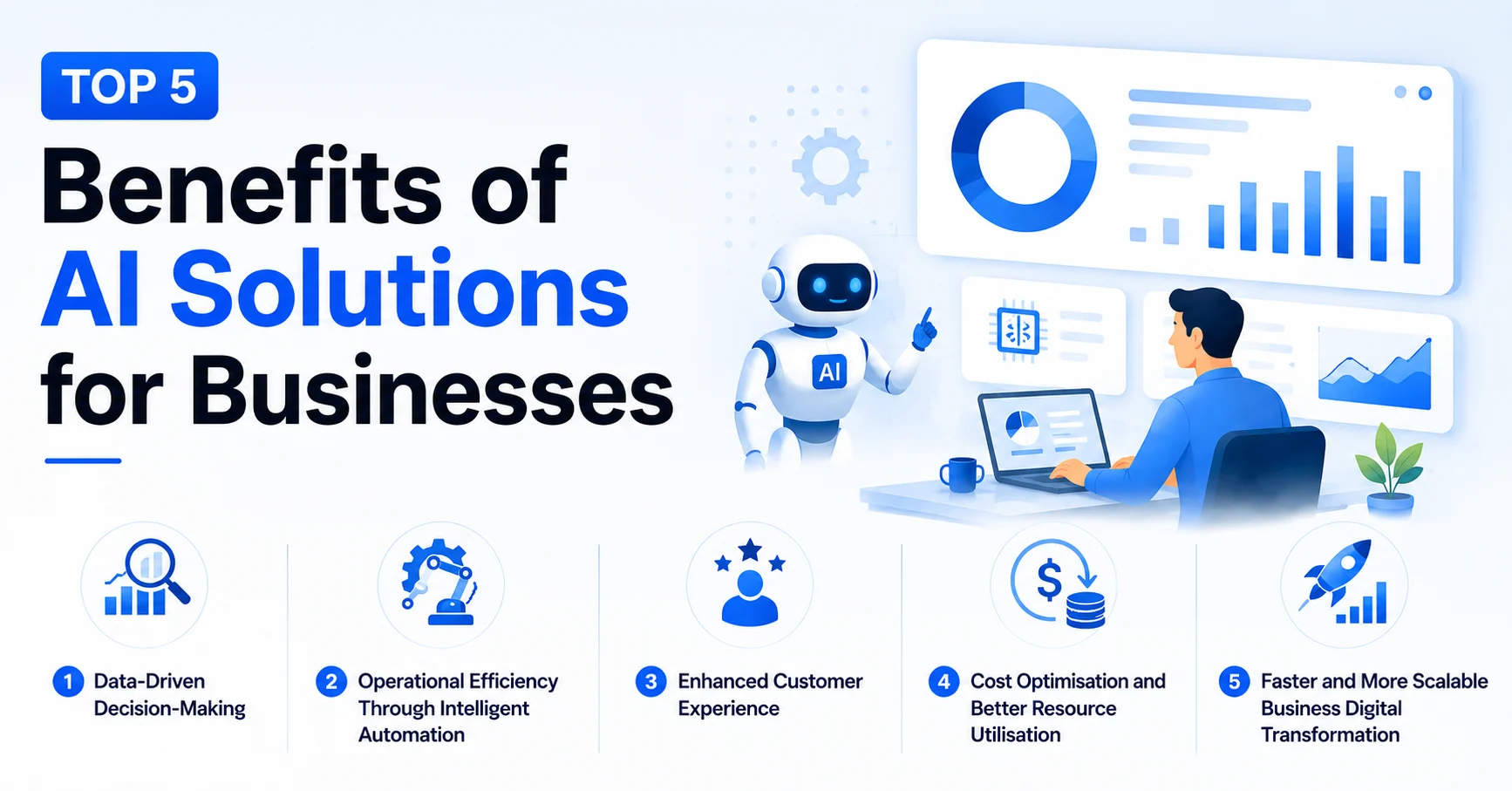
- Enhanced Decision-Making Through Data Intelligence
We rely on data to make informed decisions, but raw data alone holds limited value without interpretation. AI transforms structured and unstructured data into actionable insights.
Machine learning algorithms identify hidden patterns in customer behavior, market trends, and operational metrics. This enables businesses to:
- Forecast demand more accurately
- Optimize pricing strategies in real time
- Reduce uncertainty in strategic planning
- Improve investment decisions
By leveraging predictive intelligence, we move from reactive decision-making to proactive strategy execution.
- Operational Efficiency and Process Automation
One of the most immediate impacts of AI adoption is automation. Repetitive, rule-based tasks are delegated to intelligent systems, allowing human teams to focus on higher-value activities.
We commonly automate:
- Invoice processing and financial reconciliation
- Inventory tracking and supply chain management
- HR onboarding workflows
- Customer query handling through AI chat systems
Organizations implementing AI-driven automation experience reduced operational costs, fewer errors, and faster turnaround times. This efficiency directly contributes to scalable business growth.
- Personalized Customer Experiences at Scale
Modern customers expect tailored experiences. AI enables hyper-personalization by analyzing user behavior, preferences, and interaction history.
We use AI-powered systems to:
- Recommend products based on browsing behavior
- Deliver personalized marketing campaigns
- Adjust website content dynamically
- Improve customer support responsiveness
This level of personalization significantly increases customer retention, engagement, and lifetime value, all of which are critical for long-term business growth.
- Improved Marketing Performance and ROI
AI transforms marketing from a broad outreach strategy into a precision-targeted system. By analyzing consumer data, AI identifies high-value segments and optimal engagement channels.
We enhance marketing outcomes through:
- Predictive lead scoring
- Automated ad optimization
- Sentiment analysis on social media data
- Real-time campaign adjustments
As a result, businesses achieve higher conversion rates while reducing customer acquisition costs. AI ensures that marketing budgets are allocated efficiently and strategically.
- Strengthened Risk Management and Fraud Detection
Risk mitigation is a critical component of sustainable business growth. AI systems detect anomalies and potential threats faster than traditional methods.
We utilize AI for:
- Financial fraud detection
- Cybersecurity threat monitoring
- Compliance tracking and reporting
- Operational risk forecasting
By identifying irregular patterns early, businesses can prevent financial losses and protect brand reputation. This proactive security approach enhances overall organizational resilience.
How AI Drives Competitive Advantage in Modern Markets
We understand that competitive advantage today is defined by speed, intelligence, and adaptability. AI enables businesses to outperform competitors in all three areas.
Companies using AI systems can:
- Launch products faster based on predictive market insights
- Adapt pricing dynamically in response to demand fluctuations
- Respond to customer needs in real time
- Innovate continuously using data-backed experimentation
Organizations that fail to adopt AI risk falling behind in both operational capability and customer expectations.
AI Integration Across Business Functions
Sales and CRM Systems
We integrate AI into CRM platforms to prioritize leads, forecast sales, and automate follow-ups. Sales teams benefit from improved conversion rates and shorter sales cycles.
Human Resources Management
AI assists in talent acquisition, employee engagement analysis, and workforce planning. We reduce hiring bias and improve retention strategies through data-driven HR decisions.
Finance and Accounting
AI enhances financial forecasting, expense tracking, and anomaly detection. This leads to improved budget accuracy and stronger financial control.
Supply Chain and Logistics
We optimize supply chain operations using AI-powered demand forecasting, route optimization, and inventory management systems, ensuring reduced waste and improved delivery performance.
Challenges in AI Adoption and How We Overcome Them
Despite its advantages, AI implementation presents challenges such as data quality issues, integration complexity, and skill gaps.
We address these challenges through:
- Structured data governance frameworks
- Gradual AI integration strategies
- Employee training and upskilling programs
- Collaboration with AI technology providers such as OpenAI and other industry leaders
By taking a phased and strategic approach, organizations can minimize disruption while maximizing ROI.
Future of AI in Business Growth Strategy
We anticipate that AI will evolve from a supporting technology into a core business infrastructure component. Future developments will include:
- Fully autonomous business operations
- AI-driven strategic planning systems
- Advanced generative AI for content and product design
- Real-time global market intelligence platforms
Businesses that invest early in AI capabilities position themselves for long-term dominance in increasingly competitive markets.
Conclusion: Building an AI-First Business Ecosystem
We conclude that AI is no longer optional for businesses aiming to scale efficiently and sustainably. From decision-making and automation to marketing and customer engagement, AI solutions redefine how value is created and delivered.
Organizations that embrace AI as a core strategic asset will not only improve operational performance but also unlock new revenue streams and innovation pathways. The future of business growth is intelligent, automated, and data-driven and AI stands at the center of this transformation.
FAQs:
- What are AI solutionsinbusiness?
AI solutions are tools that use artificial intelligence to automate tasks, analyze data, and improve decision-making in business.
- How do AI solutions help business growth?
They help businesses grow by saving time, reducing costs, improving efficiency, and increasing sales through better insights.
- Can small businesses use AI?
Yes. Small businesses can use AI for marketing, customer support, automation, and better decision-making.
- Which industries use AI the most?
AI is used in retail, healthcare, finance, manufacturing, logistics, and marketing.
- What are the main challenges of using AI?
The main challenges are cost, lack of skills, data privacy, and system integration.
visit for more information: https://ledgesure.com
Source: https://edtechreader.com/