


Businesses generate large amounts of data through websites, mobile applications, customer transactions, online services, and business operations. Analysing this information in real time helps organisations understand customer behaviour, monitor business activities, and make faster decisions. Traditional data processing systems often depend on batch processing, which may take several hours to collect and analyse information.
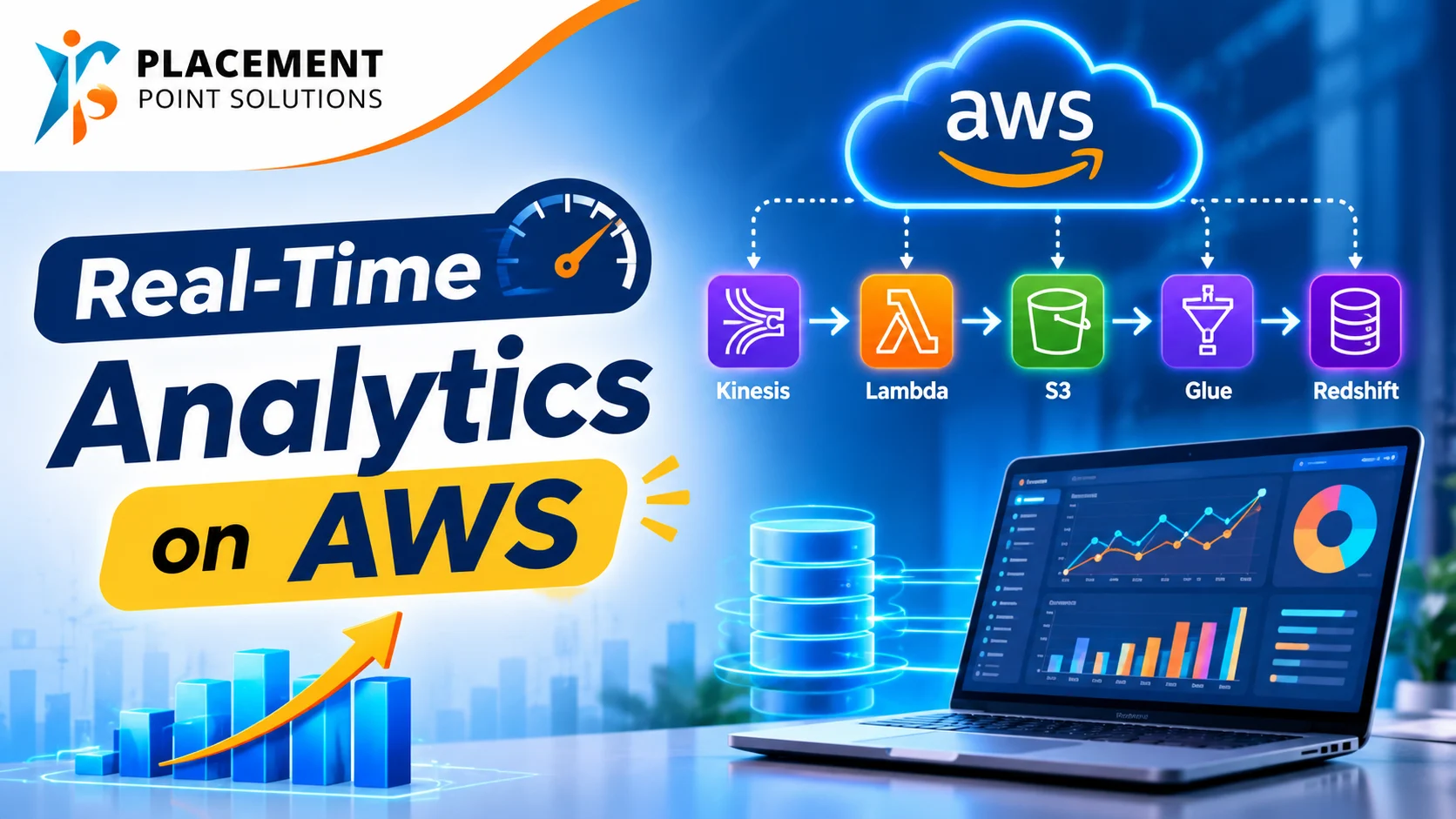
Amazon Web Services (AWS) provides cloud-based services that help businesses build scalable and reliable real-time data analytics pipelines. By combining services such as Amazon Kinesis, AWS Lambda, Amazon S3, AWS Glue, and Amazon Redshift, organisations can collect, process, store, and analyse data efficiently. Developing these technical skills through a Data Analytics Course in Chennai can help learners understand modern data processing methods and explore career opportunities in analytics.
1. Understand the Architecture of a Real-Time Data Pipeline
Before building a pipeline, it is important to understand how data moves through the system. A real-time data analytics pipeline generally includes data collection, data processing, storage, and visualisation.
For example, an e-commerce company may receive thousands of customer activities every minute. These activities include product searches, page visits, shopping cart updates, and online purchases. The pipeline collects these events and processes them continuously to generate useful business insights.
AWS offers different cloud services that support each stage of this architecture.
2. Collect Real-Time Data Using Amazon Kinesis
The first step is collecting data from different applications and sources. Amazon Kinesis is an AWS service designed to collect and process streaming data in real time.
Businesses can use Kinesis Data Streams to capture information from websites, mobile applications, IoT devices, and application servers.
For example, an online shopping platform can send customer purchase events to Kinesis whenever a transaction occurs. The service receives these events and makes them available for further processing.
This approach helps organisations handle continuous data streams without depending entirely on traditional batch-processing methods.
3. Process Streaming Data with AWS Lambda
After collecting data, the next step is processing incoming information. Developers may run code without worrying about server management thanks to AWS Lambda.
Lambda functions can process streaming events, validate records, remove unnecessary information, and transform raw data into structured formats.
For example, an online retail company can use Lambda to identify successful transactions, calculate order values, and categorise customer activities.
Because Lambda automatically scales according to incoming requests, it can support applications with changing workloads. Understanding these technologies through Cloud Computing Training in Chennai can help learners gain knowledge of cloud infrastructure, serverless computing, and modern application development.
4. Store Processed Data in Amazon S3
Data storage is another important part of a real-time analytics pipeline. Amazon Simple Storage Service (Amazon S3) provides scalable cloud storage for structured and unstructured information.
Processed streaming data can be stored in S3 for future analysis, reporting, and historical comparisons.
Organisations can organise information into folders based on dates, departments, business activities, or data categories. This makes it easier to manage large datasets and retrieve information when required.
Amazon S3 also supports integration with other AWS analytics services, making it a useful storage layer for modern data platforms.
5. Transform Data Using AWS Glue
Raw data may contain missing values, inconsistent formats, or unnecessary fields. AWS Glue helps businesses prepare and transform information for analytical purposes.
AWS Glue provides data integration and ETL capabilities. Information from many sources may be extracted, formatted appropriately, and loaded into analytical storage systems.
For example, a company can combine customer information, product details, and transaction records to create a structured dataset.
The AWS Glue Data Catalog also helps organise metadata, making datasets easier to discover and manage.
6. Analyse Data Using Amazon Redshift
After data preparation, businesses need a platform to perform analytical queries and generate insights. A cloud data warehouse called Amazon Redshift was created for extensive data analytics.
Organisations can use Redshift to analyse sales performance, customer purchasing patterns, product demand, and operational activities.
For example, an e-commerce business can identify its best-selling products, compare daily revenue, and understand customer purchasing trends.
By connecting processed datasets to Amazon Redshift, businesses can perform analytical queries and support data-driven decision-making.
7. Create Dashboards and Visual Reports
Data becomes more useful when business users can understand it through visual reports and dashboards.
Amazon QuickSight is a business intelligence service that helps organisations create interactive dashboards and visualisations.
Businesses can display important metrics such as:
- Daily sales and revenue.
- Customer activity.
- Product performance.
- Transaction volume.
- Website engagement.
- Operational performance.
These dashboards help managers monitor business activities and identify important changes without manually analysing large datasets.
8. Monitor Pipeline Performance and Security
A reliable data pipeline requires continuous monitoring and proper security management.
Amazon CloudWatch helps monitor AWS resources, application performance, and processing activities. It can also generate alarms when specific performance conditions are reached.
Access to AWS resources may be managed with the use of AWS Identity and Access Management (IAM). Permissions may be granted by organisations according to application needs and personnel responsibilities.
Additionally, encryption, access policies, and regular security reviews help protect sensitive business information.
9. Benefits of Building Real-Time Analytics Pipelines on AWS
Building a real-time data analytics pipeline on AWS provides several advantages:
Faster Decision-Making: Businesses can analyse incoming information and respond to changing conditions more quickly.
Scalability: AWS services can support increasing data volumes and changing business requirements.
Flexible Storage: Amazon S3 provides scalable storage for large amounts of information.
Improved Data Processing: Streaming and serverless services help automate data processing activities.
Better Business Insights: Analytical services and dashboards help organisations understand customer behaviour and operational performance.
Conclusion
Building a real-time data analytics pipeline on AWS involves connecting multiple cloud services to collect, process, store, and analyse streaming information. Services such as Amazon Kinesis, AWS Lambda, Amazon S3, AWS Glue, Amazon Redshift, and Amazon QuickSight work together to create an effective analytics environment.
By implementing these technologies, businesses can improve data accessibility, monitor operations, understand customer activities, and make informed decisions. Learning AWS cloud services, data processing techniques, and analytics tools can also help aspiring professionals develop practical knowledge of modern cloud-based data engineering and analytics systems.