

Academic publishing runs on relationships — with authors, with school and university procurement teams, with distributors, and with thousands of individual buyers who all expect a personal, timely response. Yet most publishing houses still track these relationships across scattered spreadsheets, inboxes, and sticky notes. That’s where academic CRM software comes in: a purpose-built system that centralizes every contact, deal, and follow-up so publishers never lose track of a lead or a manuscript deadline again.
This guide walks through what academic CRM software actually does, why book publishers need it more than ever in 2026, the features that matter most, and how to choose a platform that fits the unique rhythm of the publishing business.
What Is Academic CRM Software?
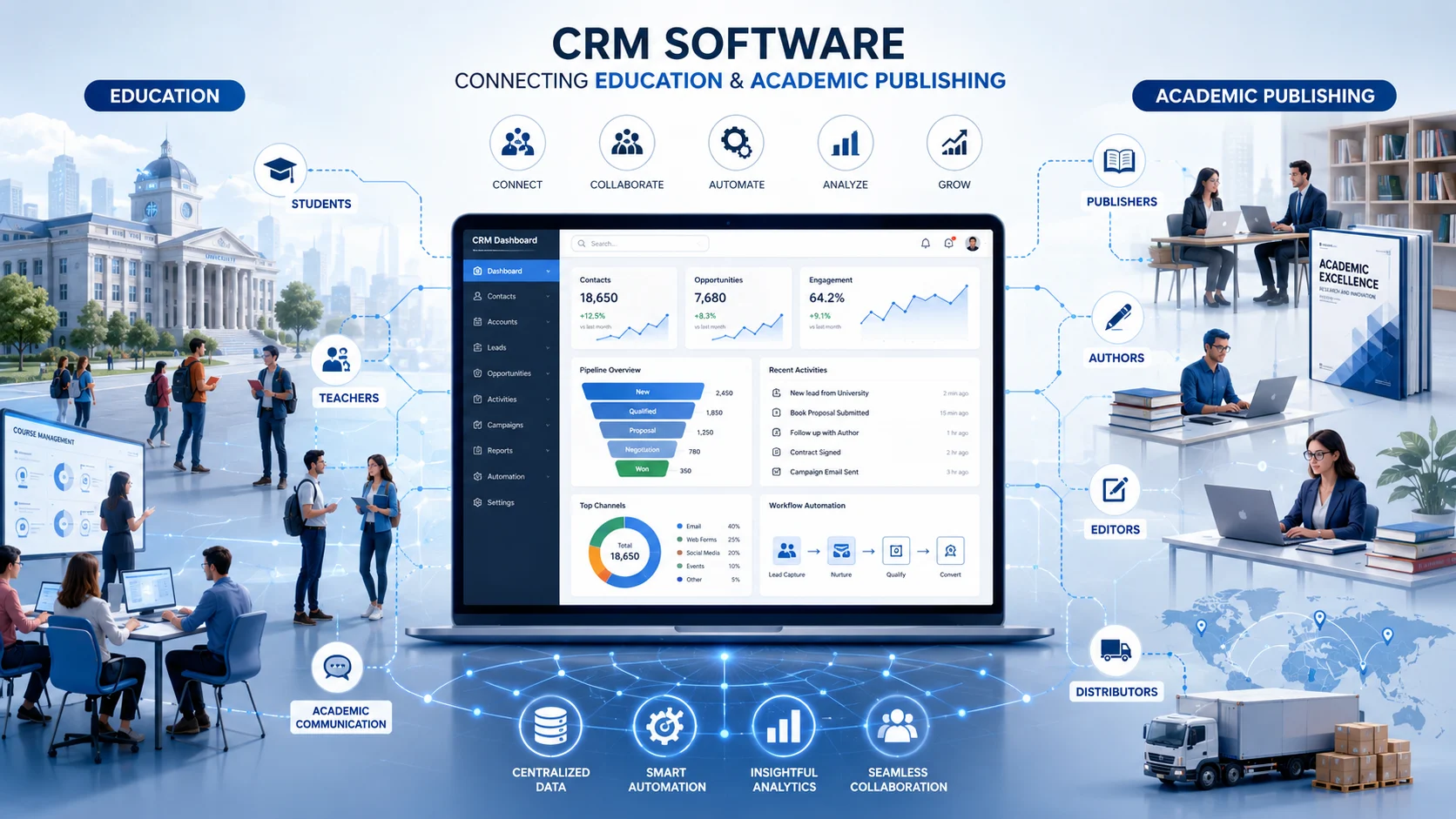
Academic CRM software is a category of customer relationship management (CRM) tools designed specifically for organizations that operate at the intersection of education and content — publishers, edtech companies, and institutions. Unlike generic sales CRMs built for retail or B2B software companies, an academic crm software platform understands publishing-specific workflows: author acquisition, manuscript pipelines, adoption cycles at schools and universities, distributor relationships, and seasonal sales cycles tied to academic calendars.
In short, it’s CRM for education built around books, courses, and institutional buyers instead of generic sales funnels.
Why the CRM Market Is Booming — And Why Publishers Can’t Ignore It
CRM adoption isn’t a niche trend anymore. According to Fortune Business Insights, the global CRM market is valued at roughly $126 billion in 2026 and is growing at a compound annual growth rate of over 12% through the early 2030s. Adoption is now near-universal among established businesses, with the vast majority of companies with ten or more employees running some form of CRM system.
Publishing houses that still rely on manual tracking are falling behind competitors who have already automated their author and institutional outreach. As covered in this guide to AI solutions for business growth, automation and smarter data systems are now a core driver of competitive advantage across industries — and publishing is no exception. For an industry where a single university adoption decision can influence revenue for years, that gap matters.
The Core Problems a Book Publishers CRM Solves
Before comparing tools, it helps to understand the specific pain points a book publishers crm is designed to fix:
1. Scattered Author Communication
Editors often juggle dozens of active manuscripts, each with its own email thread, contract status, and revision history. Without a shared system, institutional knowledge lives in one person’s inbox — and disappears when that person changes roles.
2. Fragmented Institutional Sales
Selling to schools, colleges, and universities involves long approval chains: department heads, procurement officers, and library committees. A generic spreadsheet can’t track where each institution is in that chain, when the next follow-up is due, or which sales rep owns the relationship.
3. Disconnected Distribution and Rights Data
Publishers frequently manage multiple distribution channels — direct sales, distributors, online marketplaces, and licensing deals. Without a unified system, it’s easy to lose visibility into which rights are sold where, and to whom.
4. No Single View of the Customer
A school district might buy textbooks, request a demo of a digital learning tool, and later renegotiate a multi-year licensing contract. If these interactions live in different systems, publishers lose the context needed to renew, upsell, or resolve issues quickly.
Software for publishers that solves these four problems in one place is no longer a luxury — it’s becoming table stakes for staying competitive.
Key Features to Look for in Academic CRM Management Software
When evaluating crm management software for an academic or publishing use case, prioritize these capabilities:
- Contact and institution hierarchy mapping – the ability to link individual contacts (professors, librarians, procurement officers) to their parent institution.
- Pipeline stages built for publishing – tracking manuscripts, print runs, licensing deals, and institutional adoptions separately from generic “leads.”
- Automated follow-up and task reminders – so no renewal date, contract deadline, or manuscript milestone slips through the cracks.
- Segmentation by academic calendar – campaigns and outreach that align with semester starts, budget cycles, and conference seasons.
- Reporting dashboards – visibility into which titles, territories, or sales reps are driving the most revenue.
- Integration with email, e-commerce, and distribution tools – so the CRM becomes the single source of truth rather than another silo.
- Role-based access – editorial, sales, and rights teams often need different views of the same data.
How Academic CRM Software Improves Day-to-Day Operations
The real value of a CRM isn’t the software itself — it’s the operational discipline it enforces. Teams that adopt a purpose-built academic CRM typically see:
- Faster response times to institutional inquiries, since every rep can see the full history of a contact instantly.
- Fewer missed renewals, because contract and licensing dates are tracked automatically rather than remembered manually.
- Better forecasting, since sales pipelines for institutional deals are visible in one dashboard instead of buried in individual inboxes.
- Stronger author relationships, because editorial and marketing teams share the same communication history instead of duplicating outreach.
Platforms like Vmesh CRM are built with exactly this kind of publishing and education-sector workflow in mind, combining contact management, pipeline tracking, and automation in a single system so academic publishers don’t have to stitch together multiple disconnected tools.
CRM for Education vs. Generic Business CRM: What’s Different?
A common mistake publishers make is adopting a general-purpose sales CRM and trying to force publishing workflows into it. The differences that matter most:
| Factor | Generic Business CRM | Academic / Publisher CRM |
|---|---|---|
| Pipeline structure | Generic deal stages | Manuscript, licensing, and institutional adoption stages |
| Contact hierarchy | Flat contact lists | Nested institution → department → individual structure |
| Sales cycle timing | Always-on | Aligned to academic calendars and budget cycles |
| Reporting | Revenue by rep/region | Revenue by title, territory, and institution type |
| Integrations | Generic marketing tools | Distribution, licensing, and e-commerce platforms specific to publishing |
Choosing a CRM built for education and publishing — rather than adapting a generic one — saves months of workaround configuration later.
How to Choose the Right CRM Management Software for Your Publishing House
- List your workflows first. Map out how a manuscript moves from acquisition to print, and how an institutional deal moves from first contact to signed contract. Any CRM you choose should mirror these stages, not force you to redesign them.
- Involve editorial, sales, and rights teams in the evaluation. Each team has different daily needs; a tool that only satisfies sales will get abandoned by editorial.
- Check integration depth, not just integration count. A CRM that “connects” to your email but requires manual data entry for every deal isn’t saving you time.
- Ask for a trial with real data. Import a sample of your actual contacts and institutions before committing — generic demo data hides usability issues.
- Evaluate support and onboarding. Publishing-specific CRM vendors should understand your terminology (imprints, rights, adoptions) without lengthy explanation.
Frequently Asked Questions
Is academic CRM software only for large publishing houses? No. Small and mid-sized publishers often benefit the most, since they typically lack dedicated operations teams to manually track institutional relationships. A CRM replaces that missing infrastructure.
Can a CRM for education also manage author royalties? Most CRMs focus on relationship and pipeline management rather than royalty accounting, but many integrate with finance or rights-management systems to keep data connected.
How long does it take to implement CRM management software at a publishing house? Implementation timelines vary, but a focused rollout covering core contact migration and pipeline setup can typically be completed within a few weeks, followed by ongoing refinement as teams adopt the system.
Final Thoughts
Academic publishing is a relationship business first and a content business second. As the broader CRM market continues to grow past the $120 billion mark globally, publishers who invest in purpose-built academic crm software — rather than generic sales tools — will be the ones who respond faster to institutions, retain more author relationships, and forecast revenue with real confidence.
If your publishing house is still managing authors and institutional buyers through spreadsheets, it may be time to evaluate a dedicated book publishers crm built for the way academic sales actually work.