

Artificial Intelligence and Machine Learning are changing how organizations operate, make decisions, serve customers, and develop new products. From intelligent automation and predictive analytics to generative AI and data-driven decision-making, businesses across industries are increasingly exploring ways to integrate AI into everyday operations.
This transformation is creating a growing need for professionals who understand not only the concepts behind AI and Machine Learning but also how these technologies can be applied to real business situations.
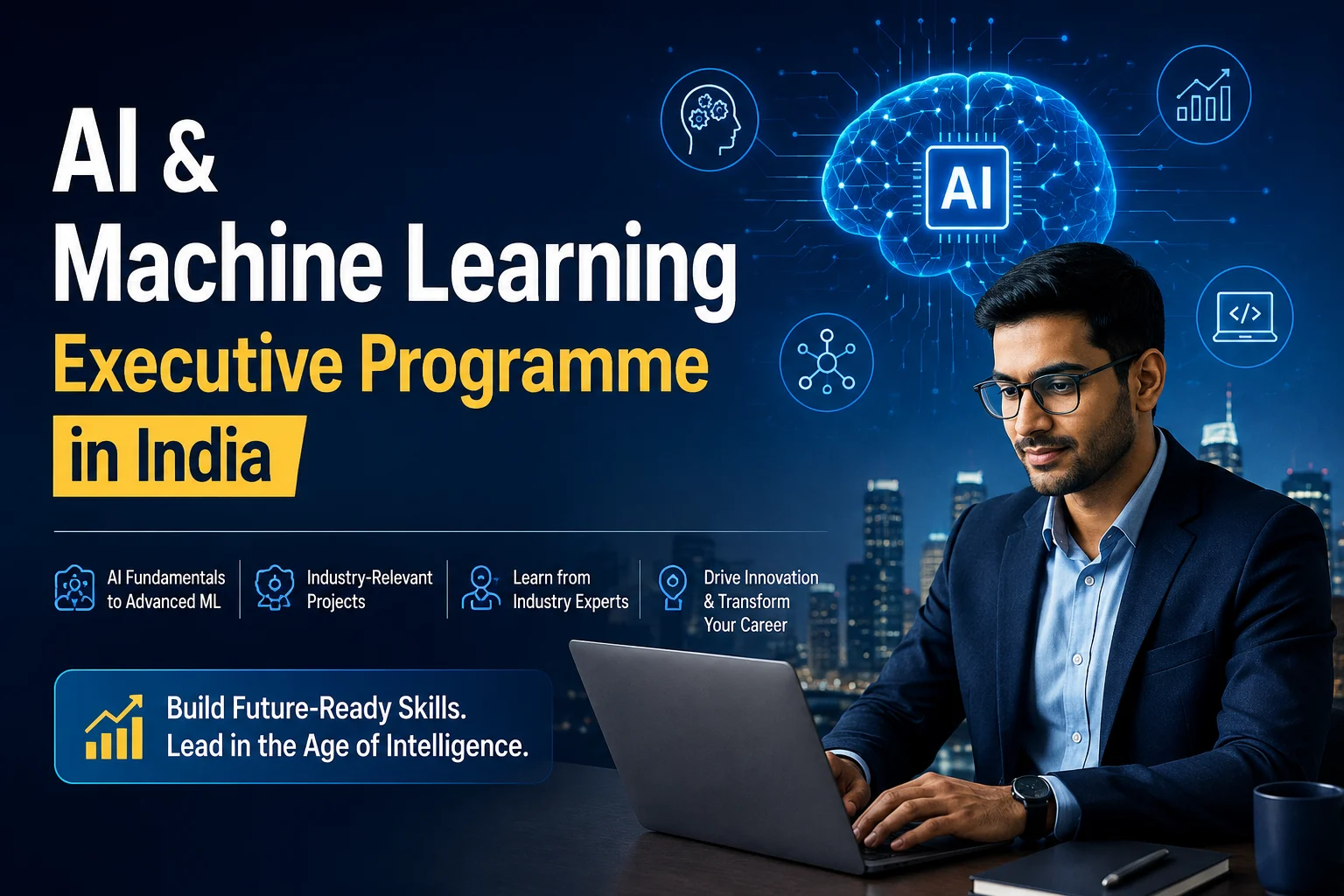
For working professionals, an AI and Machine Learning Executive Programme in India can provide an opportunity to build relevant technology knowledge while continuing their existing careers. Rather than focusing exclusively on theoretical concepts, a well-designed executive programme can connect AI principles with business strategy, implementation, innovation, and practical problem-solving.
Understanding the Growing Importance of AI and Machine Learning
AI is no longer limited to research laboratories or highly specialized technology teams. Businesses are increasingly using intelligent technologies across departments such as marketing, finance, customer service, operations, healthcare, manufacturing, retail, and logistics.
Machine Learning can help organizations identify patterns in data, generate predictions, automate selected processes, and support decision-making. Generative AI has further expanded the possibilities by enabling systems to work with text, images, audio, video, and other forms of content.
This evolution means professionals from different backgrounds may need to understand how AI works and where it can create meaningful business value.
An executive-level learning programme can help professionals develop this understanding without requiring them to completely change their career path.
Why Professionals Should Develop AI Skills
Technology adoption is creating new expectations for managers, business leaders, consultants, product professionals, analysts, and technology teams.
Professionals who understand AI can participate more effectively in conversations involving:
- AI adoption
- Digital transformation
- Automation
- Data-driven decision-making
- Product innovation
- AI strategy
- Technology investment
- Business process improvement
AI knowledge can also help professionals evaluate whether a particular problem actually requires an AI solution or whether a simpler technology approach would be more appropriate.
This business-oriented perspective is particularly valuable for professionals who are responsible for planning, managing, or implementing technology initiatives.
What Can You Learn Through an Executive AI Programme?
A comprehensive programme can cover multiple areas of Artificial Intelligence and Machine Learning.
Depending on the curriculum, professionals may explore:
Artificial Intelligence Fundamentals
Understanding core AI concepts provides the foundation for evaluating intelligent technologies and their potential applications.
Machine Learning
Machine Learning introduces methods through which systems can identify patterns and make predictions using data.
Deep Learning
Deep Learning provides an introduction to neural-network-based approaches used in areas such as computer vision, speech processing, and natural language applications.
Generative AI
Generative AI has become an important area for businesses because it can assist with content generation, summarization, research, customer interactions, software development, and other workflows.
AI Strategy
Technical knowledge alone is not enough for business leaders. Professionals also need to understand how AI initiatives can be aligned with organizational objectives.
Responsible AI
AI adoption also involves questions around privacy, security, transparency, bias, governance, and responsible implementation. Understanding these considerations can help organizations adopt AI more thoughtfully.
Practical Learning Makes AI Education More Valuable
One of the biggest advantages of a professional AI programme can be its emphasis on practical application.
Simply understanding definitions and algorithms may not prepare professionals for real-world implementation. Business environments involve complex requirements, data limitations, technical constraints, budgets, security considerations, and organizational resistance.
Practical learning can bridge the gap between theoretical knowledge and implementation.
Professionals can gain experience through:
- Business case studies
- Practical assignments
- AI projects
- Industry examples
- Capstone projects
- Problem-solving exercises
- Implementation discussions
This approach can help learners understand how AI concepts translate into actual business solutions.
AI Skills Can Support Creative and Content Workflows
The applications of AI extend beyond analytics and enterprise automation.
Professionals can understand how AI solutions are created and implemented through the acquisition of these competencies. These skills can also support applications such as creative video, where AI can help streamline content creation and improve efficiency.
AI-powered creative workflows can assist teams with activities such as generating content concepts, developing visual assets, creating video drafts, and reducing repetitive production tasks.
For marketing teams, entrepreneurs, content creators, and communication professionals, understanding these applications can help them identify practical ways to incorporate AI into their existing workflows.
Who Can Benefit From an AI Executive Programme?
AI education is not limited to software developers.
Professionals from multiple areas can benefit from developing AI literacy.
Business Managers
Managers can better understand AI opportunities and communicate with technical teams.
Product Managers
Product professionals can evaluate how AI capabilities can be incorporated into digital products.
Marketing Professionals
Marketing teams can explore AI applications for personalization, content creation, customer insights, and campaign optimization.
Operations Professionals
Operations teams can identify repetitive processes that may benefit from intelligent automation.
Technology Leaders
Technology professionals can strengthen their understanding of emerging AI architectures, applications, and implementation strategies.
Entrepreneurs
Business owners can evaluate AI opportunities for improving efficiency, customer experience, and product innovation.
How AI Knowledge Can Improve Career Opportunities
The growing adoption of AI is influencing the skills organizations seek from professionals.
AI knowledge can complement existing expertise rather than replacing it.
For example, a marketing professional with AI knowledge can explore AI-powered marketing workflows. A product manager can better evaluate AI-enabled product features. An operations manager can identify automation opportunities.
This combination of domain expertise and AI literacy can create a stronger professional profile.
Rather than becoming an AI specialist immediately, professionals can begin by understanding how AI relates to their current responsibilities.
Choosing the Right Executive AI Programme
The quality of an executive programme depends heavily on its curriculum, teaching approach, faculty, practical exposure, and relevance to current industry requirements.
Before enrolling, professionals should evaluate several factors.
1. Industry-Relevant Curriculum
The programme should cover foundational AI concepts while also addressing current technologies and business applications.
2. Practical Projects
Look for programmes that provide opportunities to work on practical problems rather than focusing entirely on lectures.
3. Experienced Faculty
Faculty with strong academic or industry experience can provide useful context around how AI technologies work in real environments.
4. Business Perspective
Professionals should learn how AI can contribute to business outcomes rather than studying technology in isolation.
5. Flexible Learning
Working professionals need a learning structure that can fit around their professional responsibilities.
Online sessions, weekend classes, recorded materials, or flexible schedules can make continued education more manageable.
6. Emerging Technologies
AI is developing rapidly. A relevant programme should provide exposure to areas such as generative AI, modern Machine Learning approaches, AI applications, automation, and responsible AI.
AI Learning Is an Ongoing Process
Completing an executive programme should not be considered the end of AI learning.
Artificial Intelligence continues to evolve rapidly. New models, tools, frameworks, applications, and business use cases emerge regularly.
Professionals should therefore develop a habit of continuous learning.
They can continue building expertise through:
- Industry research
- Professional communities
- Practical experimentation
- AI projects
- Workshops
- Technical publications
- Business case studies
Continuous learning can help professionals remain adaptable as AI capabilities change.
Connecting AI Education With Business Goals
The ultimate value of AI education comes from applying knowledge to meaningful problems.
Before implementing an ai development company in usa, organizations should ask:
- What business problem are we trying to solve?
- Is AI the right approach?
- What data is available?
- What will implementation cost?
- What measurable outcome should we expect?
- How will the solution be monitored?
- What security and governance requirements apply?
Professionals who can connect these questions with AI capabilities can play an important role in successful digital transformation.
Conclusion
Artificial Intelligence and Machine Learning are becoming increasingly relevant across India’s business and technology ecosystem. As organizations explore automation, intelligent applications, generative AI, analytics, and digital transformation, professionals with practical AI knowledge can contribute more effectively to these initiatives.
An AI and Machine Learning Executive Programme in India can provide working professionals with a structured path to understand AI technologies, business applications, implementation challenges, and emerging opportunities.
The most valuable programmes are those that combine foundational knowledge with practical projects, industry relevance, experienced guidance, and flexible learning.
For professionals looking to remain competitive in an increasingly technology-driven environment, developing AI and Machine Learning knowledge can be a meaningful step toward building future-ready capabilities.