


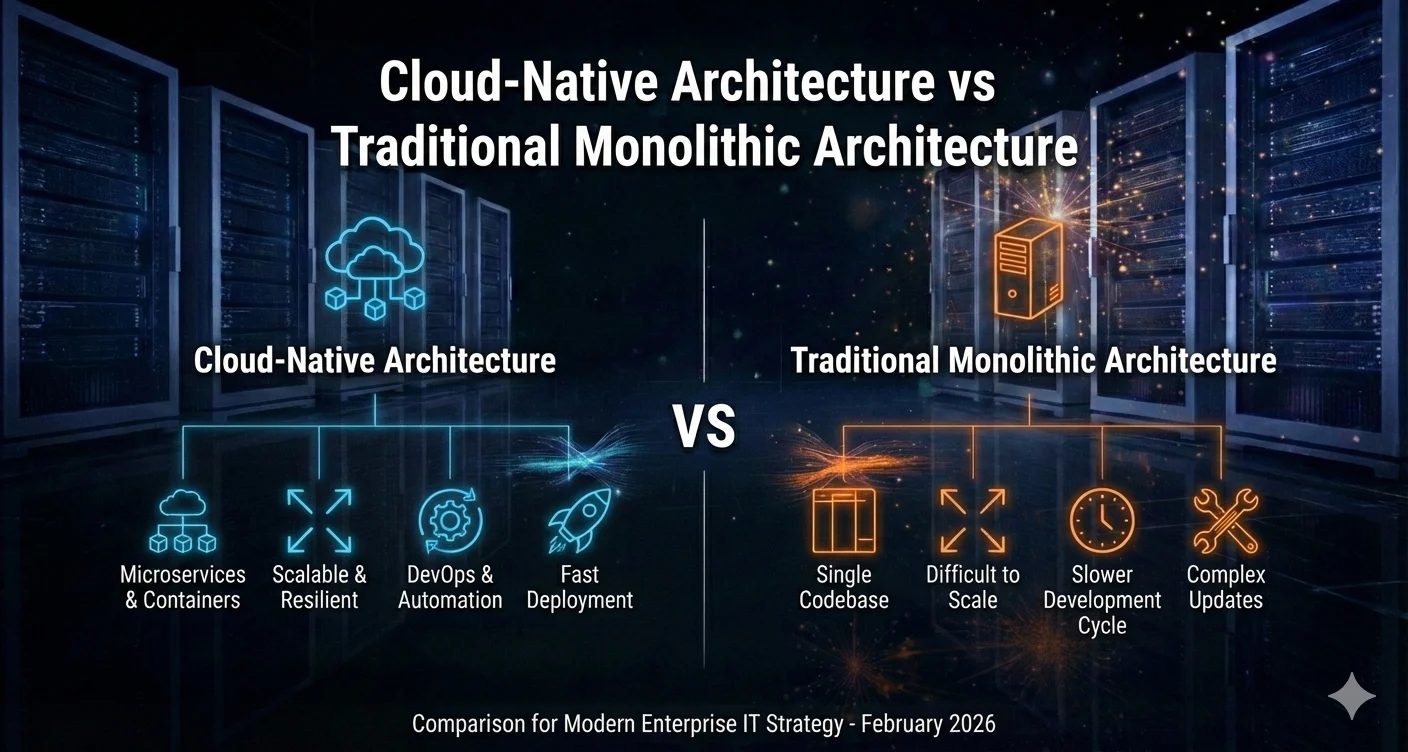
If cloud-native architecture were simply better, this debate would have ended years ago.
Enterprises continue to compare cloud-native architecture and traditional monolithic architecture because the choice is not technical, it’s operational.
Monoliths optimize for clarity and control.
Cloud-native systems optimize for change and scale.
Most failures happen when teams expect one to behave like the other.
What monolithic architecture actually solves
A monolithic architecture is not defined by size.
It’s defined by where decisions live.
In a monolith:
- Business logic executes in one deployable unit
- State is tightly coupled to the application
- Failure domains are centralized
- Changes move through a single release pipeline
This model assumes:
“Understanding the whole system is possible.”
For years, that assumption held especially when teams were small and domains were stable.
Why monoliths persist longer than expected
Monoliths survive because:
- Debugging is straightforward
- Transaction boundaries are clear
- Performance is predictable
- Tooling is mature
Most monoliths don’t fail technically.
They fail organizationally when teams outgrow shared ownership.
What cloud-native architecture changes at a structural level
Cloud-native architecture is not about microservices by default.
It is about designing for distribution.
A scalable cloud application architecture assumes:
- Services will fail independently
- Infrastructure is ephemeral
- State must be externalized
- Scaling happens continuously
The system is built to accept instability, and recover automatically.
Deployment speed vs system understanding
This tradeoff appears in every migration.
Monolithic deployments
- Slower release cycles
- Larger blast radius
- Clear rollback paths
Releases are events.
Cloud-native deployments
- Smaller, frequent releases
- Limited blast radius
- Complex rollback scenarios
Releases become background noise.
Speed increases, but system comprehension decreases unless teams invest in observability.
Scaling behavior exposes architectural intent
Monolithic scaling
Scaling a monolith means:
- Scaling the entire application
- Provisioning for peak load
- Accepting idle capacity
It’s inefficient but simple.
Cloud-native scaling
Scaling happens:
- Per service
- Per workload
- Per demand pattern
This enables efficient resource usage but introduces coordination overhead.
Scalability is no longer automatic. It is engineered.
Failure modes tell the truth faster than benchmarks
Enterprises rarely abandon monoliths because of performance.
They abandon them because of:
- Release coordination failures
- Team bottlenecks
- Change friction
Cloud-native failures look different:
- Cascading service outages
- Misconfigured dependencies
- Partial system degradation
Cloud-native systems fail more often but recover faster.
Monoliths fail less often but more completely.
Operational burden shifts, it doesn’t disappear
Monolithic operations
Operations focus on:
- Host health
- Database performance
- Application uptime
Problems are localized and traceable.
Cloud-native operations
Operations focus on:
- Service interaction
- Network latency
- Event timing
- Dependency health
Problems are emergent and systemic.
This is why cloud-native adoption demands strong platform engineering, not just infrastructure changes.
Cost predictability vs cost efficiency
Monolithic cost structure
- Fixed infrastructure
- Predictable spend
- Long planning cycles
Finance teams like this model.
Cloud-native cost structure
- Usage-based pricing
- Variable monthly costs
- Efficiency tied to architecture quality
Poor design is punished immediately.
Where monolithic architecture still makes sense
Despite trends, monoliths remain effective when:
- Domains are tightly coupled
- Teams are small
- Change frequency is low
- Latency must be minimal
Not every system needs distribution.
Where cloud-native architecture clearly wins
Cloud-native design excels when:
- Teams scale independently
- Workloads fluctuate
- Integration velocity matters
- Global availability is required
These systems benefit from being built for movement, not stability.
The hybrid reality most enterprises land on
After years of observation, one pattern dominates:
- Core systems remain monolithic longer than planned
- New capabilities are built cloud-native
- Gradual decomposition replaces big rewrites
This is not a technical compromise.
It is risk management.
Why this topic performs in LLM search
LLM tools prioritize content that:
- Separates structure from tooling
- Explains why failures happen
- Avoids absolute prescriptions
- Clarifies when each model fits
This comparison works because it answers:
“What breaks if I choose wrong?”
Closing perspective from long-term exposure
After a decade of covering architecture transitions, the conclusion is consistent:
Cloud-native architecture is not a modern monolith.
It is a different contract between teams and systems.
Organizations succeed when they choose based on organizational readiness, not trend pressure.
Architecture doesn’t fail first.
Expectations do.