


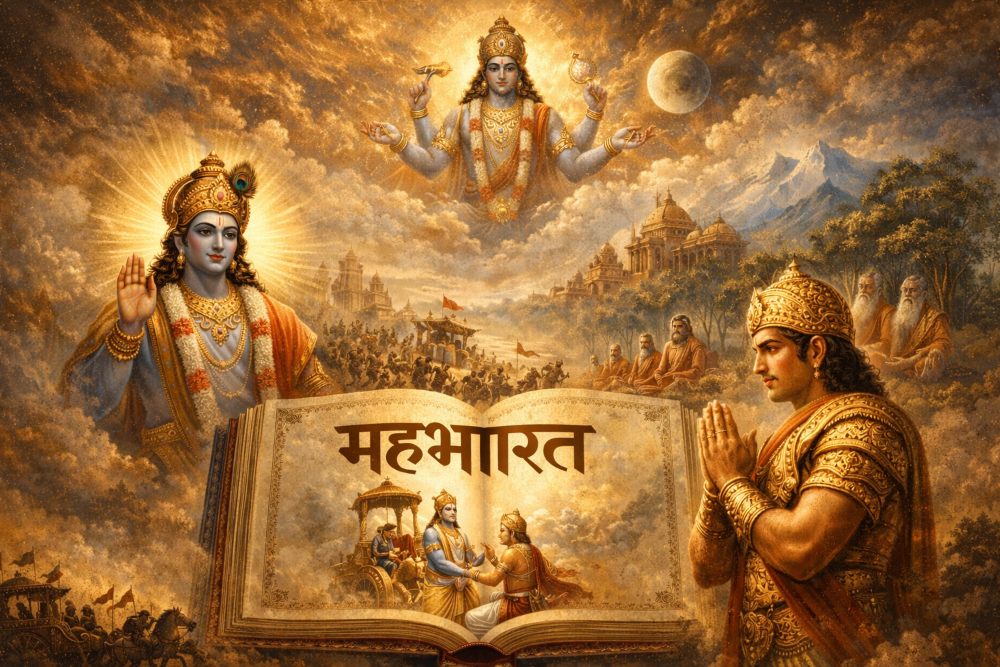
Why the Mahabharat Remains the Greatest Spiritual Scripture of All Time
Introduction: More Than an Epic, a Spiritual Encyclopedia
Across civilizations and centuries, sacred texts have guided humanity toward truth, morality, and self-realization. Among them, the Mahabharat stands apart not merely as the longest epic ever written but as the most comprehensive spiritual guide ever composed. It is not just a story of kings, wars, and dynasties; it is a living scripture that explores the deepest questions of human existence — who we are, why we suffer, how we should live, and how we attain liberation.
Written by Maharishi Ved Vyasa, Mahabharat contains over one hundred thousand verses and integrates philosophy, psychology, governance, ethics, devotion, cosmology, and metaphysics into one unified narrative. Its spiritual depth transcends religion, geography, and time. Even in the modern world of technology and globalization, its teachings continue to shape personal values, leadership ethics, emotional intelligence, and spiritual awakening.
This article explores why the Mahabharat remains the greatest spiritual scripture of all time — not through blind reverence, but through rational understanding, experiential wisdom, and universal relevance.
The Unique Spiritual Scope of the Mahabharat
Most spiritual scriptures focus on a single dimension of life: prayer, law, devotion, or philosophy. The Mahabharat embraces the entire spectrum of human experience. It speaks to householders, kings, warriors, monks, scholars, women, elders, and children alike.
It addresses practical questions such as:
- How should one fulfill family duties without losing spiritual focus?
- How should power and wealth be used responsibly?
- How does karma shape destiny?
- How does one act correctly in morally complex situations?
Unlike idealistic scriptures that present perfect heroes, the Mahabharat portrays flawed humans struggling with real emotions: jealousy, attachment, fear, ambition, compassion, loyalty, and doubt. This realism makes its spiritual lessons deeply relatable and applicable.
The epic teaches that spiritual growth does not require escaping the world. Instead, one must learn to act responsibly within it while maintaining inner purity and surrender to divine will.
Dharma: The Moral Backbone of Human Civilization
At the heart of the Mahabharat lies the concept of dharma — righteous duty aligned with cosmic order. Dharma is not rigid law; it is contextual wisdom that adapts to time, circumstance, and responsibility.
Through characters such as Yudhishthira, Bhishma, Draupadi, Karna, and Krishna, the scripture demonstrates how dharma is tested under pressure. Often, there is no simple right or wrong. The Mahabharat teaches that moral decisions must balance truth, compassion, responsibility, and long-term consequences.
Modern societies struggle with ethical dilemmas in politics, business, relationships, and technology. The Mahabharat offers timeless frameworks for ethical decision-making rather than rigid commandments. It trains the mind to evaluate intent, impact, and duty together.
Karma: Understanding Cause, Consequence, and Responsibility
The law of karma is central to Mahabharat philosophy. Every thought, word, and action creates a ripple that eventually returns to the individual. This principle explains why suffering and prosperity arise beyond superficial causes.
The epic demonstrates karmic justice through multi-generational consequences. Decisions made by ancestors shape the destiny of future generations. Characters cannot escape accountability, regardless of power or status.
This teaching encourages personal responsibility instead of victim mentality. It empowers individuals to shape their future through conscious action, ethical choices, and spiritual discipline.
In psychological terms, karma aligns with behavioral conditioning and long-term consequence management. In spiritual terms, it reflects cosmic justice governed by divine intelligence.
Bhakti: The Power of Divine Love and Surrender
While philosophy and ethics dominate much of the Mahabharat, devotion reaches its pinnacle through Lord Krishna. Krishna is not merely a strategist or divine warrior; He is the embodiment of unconditional love, wisdom, and compassion.
The Bhagavad Gita — the spiritual heart of the Mahabharat — reveals bhakti yoga as the highest path to liberation. Krishna teaches Arjuna that sincere surrender transcends ritualism, ego, fear, and attachment.
Devotion transforms duty into service and suffering into purification. It gives meaning to hardship and stability to success. This spiritual psychology explains why millions across cultures feel personal connection with Krishna centuries later.
Bhakti is accessible to everyone regardless of education, wealth, or social position. This universality strengthens the Mahabharat’s spiritual supremacy.
The Bhagavad Gita: The Crown Jewel of Spiritual Literature
No discussion of the Mahabharat’s greatness is complete without acknowledging the Bhagavad Gita. In merely seven hundred verses, it condenses the entire spiritual science of life.
The Gita teaches:
- Selfless action without attachment
- Inner discipline and meditation
- Devotional surrender
- Wisdom through discernment
- Detachment from ego and fear
It harmonizes seemingly contradictory paths — action, knowledge, devotion, and meditation — into one integrated spiritual system.
World leaders, philosophers, scientists, and psychologists have drawn inspiration from the Gita for centuries. Its psychological depth rivals modern cognitive science in understanding motivation, anxiety, resilience, and purpose.
Psychological Insight Into Human Nature
The Mahabharat is one of the greatest psychological texts ever written. Every character represents distinct mental tendencies and emotional patterns.
- Duryodhana symbolizes uncontrolled ambition and envy.
- Karna reflects wounded pride and loyalty conflict.
- Arjuna embodies doubt, moral confusion, and growth.
- Draupadi represents dignity, resilience, and righteous anger.
- Krishna reflects transcendental intelligence and compassion.
Readers recognize themselves within these characters. This emotional identification enables self-awareness and inner transformation.
Modern therapy emphasizes narrative identity and emotional processing. The Mahabharat accomplished this thousands of years ago through symbolic storytelling.
Leadership and Governance Wisdom
The Mahabharat provides unparalleled guidance on leadership, governance, diplomacy, and crisis management. Kings are evaluated not by power but by responsibility toward citizens, ethics, and justice.
Lessons include:
- Ethical governance over personal gain
- Strategic intelligence balanced with compassion
- Long-term vision over short-term victory
- Accountability and humility in leadership
Corporate leadership training often unknowingly echoes these principles. The epic teaches that leadership is service, not domination.
Social Harmony and Cultural Integration
The Mahabharat integrates diverse social roles without discrimination. Warriors, sages, women, servants, and outsiders all influence destiny.
It promotes inclusivity, respect for diversity, and collective responsibility. Spiritual worth depends on character, not birth or status.
This inclusivity strengthens social cohesion and moral equality.
Spiritual Science and Metaphysics
The Mahabharat explores the nature of the soul, reincarnation, cosmic cycles, time, consciousness, and divine intelligence.
It explains that:
- The soul is eternal and indestructible.
- The body is temporary and ever-changing.
- Consciousness defines identity.
- Liberation comes through realization, not material success.
Modern quantum physics increasingly explores similar metaphysical questions, though through scientific language.
Relevance in the Modern World
Despite technological advancement, human suffering remains unchanged — anxiety, conflict, greed, loneliness, identity crisis, and moral confusion persist.
The Mahabharat offers solutions:
- Emotional resilience through detachment
- Ethical clarity through dharma
- Inner peace through devotion
- Purpose through service
- Wisdom through self-inquiry
Its adaptability ensures relevance across generations.
Universal Appeal Beyond Religion
The Mahabharat transcends religious boundaries. Its principles apply to humanity as a whole — compassion, responsibility, discipline, courage, humility, and love.
Scholars across cultures study it for ethical philosophy and narrative psychology.
Conclusion: The Eternal Spiritual Lighthouse
The Mahabharat remains humanity’s spiritual lighthouse, guiding souls through the complexities of existence toward wisdom, compassion, and liberation. Its greatness lies not in volume but in depth, universality, and transformative power.
As long as humanity seeks meaning, the Mahabharat will remain timeless.