


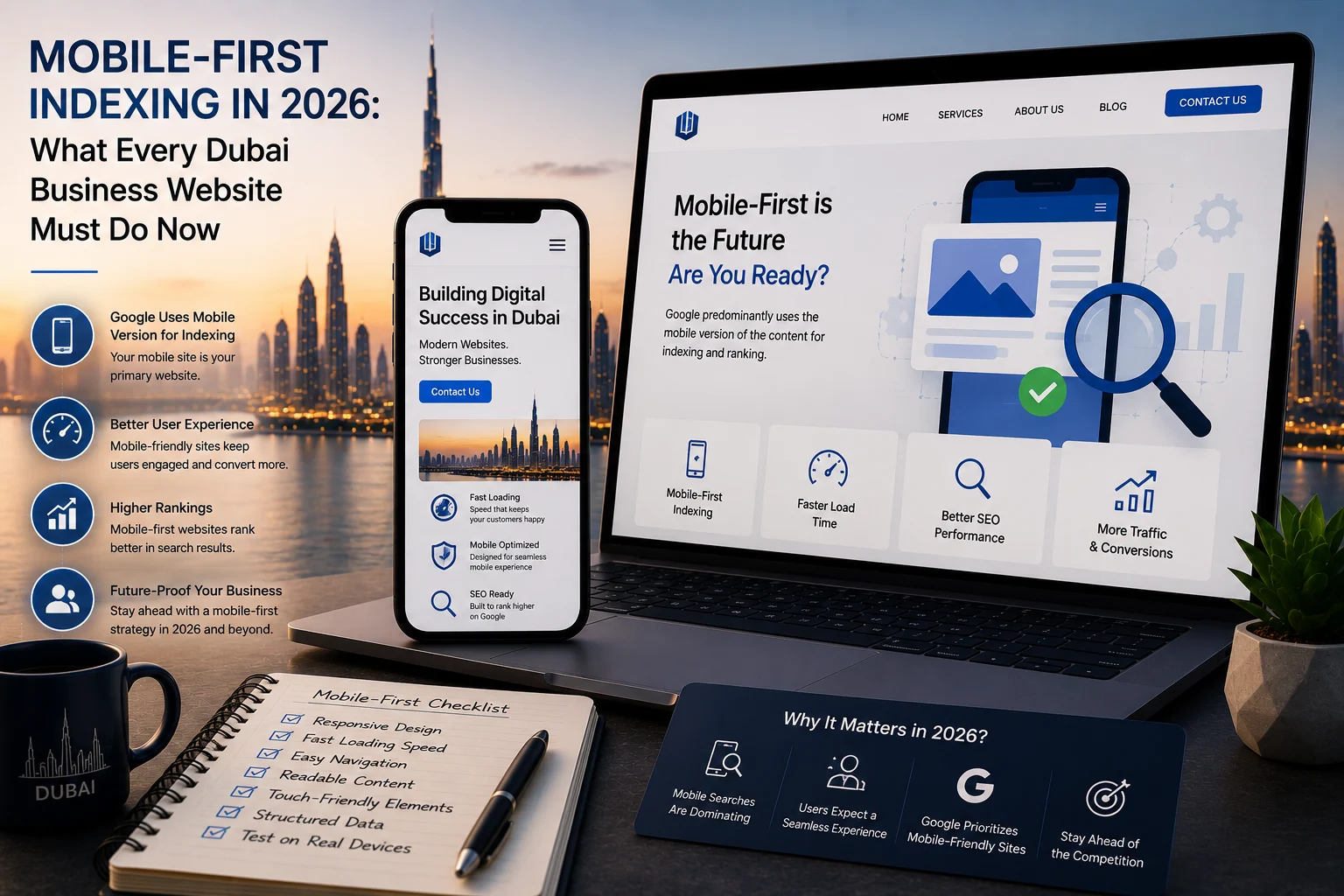
The web design cost in Dubai in 2026 must account for mobile-first indexing as a non-negotiable baseline requirement, not a premium feature, not an optional upgrade, but the foundational standard that determines whether your website exists in Google’s eyes at all. Since Google completed its transition to mobile-first indexing across all websites in 2023, every Dubai business website has been ranked and indexed based on its mobile version. In 2026, three years into this reality, a significant proportion of Dubai websites are still not meeting the standards that mobile-first indexing requires.
The UAE has one of the highest smartphone penetration rates on earth, 97.6% as of 2026. Over 74% of all web traffic in the UAE originates from mobile devices. Dubai’s car-dependent lifestyle, its geography of malls, business districts, and residential communities connected by highways, and its population of busy professionals and international visitors all create a predominantly mobile online audience. A website that performs well on desktop but poorly on mobile is not just failing its users; it is failing Google’s indexing requirements and ranking below its potential for every search term it targets.
What Mobile-First Indexing Actually Means in 2026
Mobile-first indexing means Google’s crawlers visit your website using a smartphone user agent, simulating how a mobile browser accesses your pages. The content, structure, and performance that Google’s mobile crawler encounters are what determine your website’s ranking in search results for all users, desktop and mobile alike.
This has a specific, practical implication that many Dubai business owners still do not fully understand: if content exists on your desktop website but not on your mobile website, Google does not see it. If your mobile website has fewer pages, less text, smaller images, or missing navigation elements compared to your desktop version, Google ranks you based on the reduced mobile version, not the full desktop version.
In 2026, with mobile-first indexing fully established, websites that have separate mobile versions (m.site.com) that differ substantially from their desktop versions are at particular risk. Modern responsive design, where one website adapts to all screen sizes, is the recommended approach, but only if the responsive implementation is genuinely high quality.
The 2026 Mobile Standards Google Applies to Dubai Websites
Google’s mobile-first crawling in 2026 evaluates your website against several specific standards. Understanding each helps identify which areas your website needs to address.
Content Parity Between Mobile and Desktop
Every piece of content on your desktop website must also be present on your mobile version. This includes:
- All text content, body copy, headings, meta descriptions
- All images with their alt text attributes
- All links in navigation and within content
- All structured data markup
Common Dubai website failure: Hamburger menus that hide navigation items from Google’s mobile crawler, or mobile designs that collapse and hide sections of text that are visible on desktop.
Mobile Page Speed, The 2026 Standard
Google’s mobile page speed requirements have become more stringent in 2026. The target benchmarks are:
- Largest Contentful Paint (LCP): Under 2.5 seconds on mobile
- Interaction to Next Paint (INP): Under 200 milliseconds
- Cumulative Layout Shift (CLS): Under 0.1
- Time to First Byte (TTFB): Under 800 milliseconds
Field data from UAE mobile connections, which varies between excellent 5G in commercial areas and slower connections in residential and suburban areas, shows that many Dubai websites that appear adequately fast on office Wi-Fi perform significantly worse on mobile networks.
Test your current mobile speed: Go to pagespeed.web.dev, enter your URL, and check your mobile score. A score below 50 indicates serious issues affecting your Google rankings. Between 50 and 70 indicates meaningful room for improvement. Above 70 is acceptable. Above 85 is good.
Mobile Usability – Technical Requirements
Google Search Console’s mobile usability report identifies specific technical failures that affect mobile indexing:
Text too small to read: Body text on mobile must be at minimum 12px; smaller text is flagged as a mobile usability failure.
Clickable elements too close together: Buttons and links must be at minimum 48px × 48px with adequate spacing between them to allow accurate tapping. Navigations with densely packed links that are difficult to tap accurately on a phone screen are flagged.
Content wider than screen: Any content that requires horizontal scrolling on a mobile device, images, tables, or embedded content creates a mobile usability failure.
Viewport not configured: The HTML viewport meta tag must be correctly configured for proper mobile rendering. Without it, Google’s mobile crawler sees a desktop-sized page rendered at desktop scale.
What a Mobile-First Website Must Include in 2026
A Dubai website that meets 2026 mobile-first indexing standards is not simply a desktop website that “also works on mobile.” It is a website designed and built with mobile as the primary experience, then adapted for larger screens.
Responsive Design Built Mobile-First
A mobile-first responsive design starts with the narrowest viewport (a standard smartphone, approximately 390px wide) and scales up to tablets and desktops. This approach produces better mobile performance than designing for desktop and then “making it responsive”, because every design decision starts from the most constrained environment.
Touch-Optimised Interface Elements
All interactive elements, buttons, navigation items, form fields, and dropdown menus must be designed for thumb interaction, not mouse cursor precision. This means:
- Minimum 44px × 44px tap targets
- Adequate spacing between adjacent interactive elements
- Form fields large enough to tap accurately without zooming
- No hover-only interactions (hover does not exist on touchscreens)
Mobile-Optimised Images
Images on a mobile website should be:
- Served at the correct size for the device, a 2000px wide image is unnecessary on a 390px wide phone screen
- Compressed to the smallest file size without visible quality loss
- Served in modern formats, WebP or AVIF, which provide equivalent visual quality at 25-35% smaller file size than JPEG
- Lazy loaded, images below the fold should only load when the user scrolls toward them
Fast-Loading Critical Resources
The resources needed to render the visible content of your mobile homepage, CSS, fonts, and the hero image, should load as fast as possible. Resources that are not needed for the initial render should be deferred.
Readable Typography
Text on mobile must be readable without zooming. Body text should be a minimum of 16px for body copy. Line height should be 1.5–1.6 for comfortable mobile reading. Line length should be 50–75 characters; wider text becomes difficult to read on a narrow screen.
The Most Common Mobile-First Failures on Dubai Websites in 2026
Based on data from Google Search Console across Dubai-registered websites, the most frequently occurring mobile usability issues are:
1. Unoptimised hero images (affects LCP): Large header images loaded at desktop resolution on mobile, causing slow LCP on mobile connections. Affects approximately 45% of Dubai business websites.
2. Third-party script blocking (affects INP and LCP): Chat widgets, analytics tools, marketing pixels, and social media embeds that load synchronously and block the browser’s rendering of page content. Affects approximately 38% of Dubai business websites.
3. Text too small to read: Particularly common on websites built with desktop-first design where text sizes were set for desktop screens and the mobile view simply compresses them. Affects approximately 22% of Dubai business websites.
4. Clickable elements too close together: Dense navigation menus and link clusters that are easy to use with a mouse but difficult to tap accurately on a phone. Affects approximately 19% of Dubai business websites.
5. Content wider than screen: Tables, maps, and images that overflow the mobile viewport and require horizontal scrolling. Affects approximately 15% of Dubai business websites.
Cost of Mobile-First Compliance for Dubai Websites in 2026
| Issue | Fix Required | Cost Range (AED) |
|---|---|---|
| Hero image optimisation | Compression, resizing, WebP conversion | 800 – 2,500 |
| Third-party script optimisation | Deferred loading implementation | 2,000 – 6,000 |
| Typography fixes | CSS updates for mobile text sizing | 500 – 1,500 |
| Touch target improvements | UI component resizing and spacing | 1,000 – 3,000 |
| Viewport configuration | HTML meta tag and CSS updates | 300 – 800 |
| Full mobile audit and remediation | Comprehensive fix of all issues | 5,000 – 18,000 |
| New mobile-first build (if existing site is unfixable) | Complete rebuild on mobile-first foundation | 10,000 – 45,000 |
FAQs
Q1. My website looks fine on my phone – does it still need mobile-first optimisation?
Looking acceptable and performing well for Google’s mobile-first indexing are different things. Your phone likely has a fast processor and a good connection. Google’s mobile crawler simulates a mid-range device on a typical mobile network. Run your URL through pagespeed.web.dev and check the mobile score; this tells you how Google sees your website, not how it looks on your personal device.
Q2. If Google completed mobile-first indexing in 2023, why does it still matter in 2026?
Because many Dubai websites are still not meeting the standards, meaning they are being ranked based on a mobile experience that is worse than their desktop experience. And because Google continues to update its mobile quality signals, including the ongoing evolution of Core Web Vitals metrics. Mobile-first is the established standard, but the specific benchmarks within that standard continue to be refined.
Q3. Does my website need a separate mobile version or is responsive design sufficient?
Responsive design, one website that adapts to all screen sizes, is Google’s recommended approach and is sufficient when properly implemented. A separate mobile subdomain (m.yoursite.com) creates content management complexity and risks content parity issues. Responsive design built mobile-first is the 2026 standard for new Dubai websites.
Q4. How do I check my website’s mobile usability issues specifically?
Google Search Console > Experience > Mobile Usability shows all pages on your website with detected mobile usability failures, categorised by issue type. This is free, specific to your actual website, and updated regularly as Google re-crawls your pages.
Q5. How much does it cost to rebuild a non-mobile-first website in Dubai in 2026?
A complete rebuild of an existing desktop-first website on a proper mobile-first foundation costs AED 10,000 – 45,000 depending on the website’s complexity, content volume, and platform. For websites where mobile issues are specific and addressable without a full rebuild, targeted remediation costs AED 5,000 – 18,000. A professional audit (AED 2,000 – 5,000) identifies which approach is more appropriate for your specific website.
Knowing the web design cost in Dubai in 2026 means knowing the mobile-first cost. Because a website that fails Google’s mobile-first indexing standards is a website ranking below its potential for every search term, every day, in a city where 74% of web traffic comes from mobile devices, which Google now uses to judge every website it ranks.