


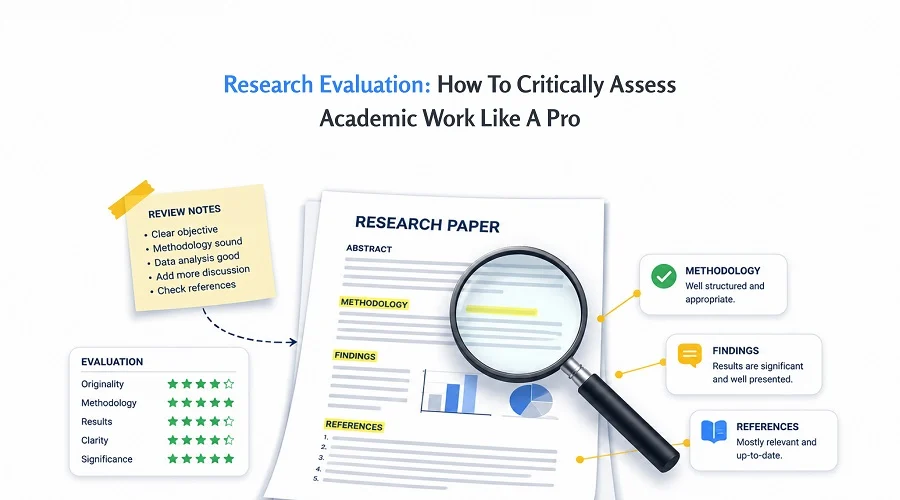
Let’s be honest-reading a research paper is one thing, but evaluating it? That’s where the real intellectual heavy lifting begins. Whether you’re reviewing literature, preparing for your viva, or writing a publication, Research Evaluation isn’t just a skill-it’s a survival tool. And the sooner you get comfortable with it, the sharper your academic thinking becomes.
What Is Research Evaluation (And Why It’s Not Just “Reviewing”)?
At a glance, Research Evaluation might sound like summarizing or critiquing a paper. But it goes deeper.
You’re not just asking what did the author do?
You’re asking how well did they do it-and does it actually hold up?
It involves systematically assessing:
- Methodology
- Data quality
- Validity of conclusions
- Relevance to the field
In short, it’s about separating solid research from well-written-but weak-arguments.
Why Research Evaluation Matters More Than You Think
Here’s the uncomfortable truth: not all published research is high quality.
And as a PhD scholar, you’re expected to know the difference.
Strong Research Evaluation helps you:
- Build credible literature reviews
You’re not just citing-you’re curating
- Avoid flawed foundations
Weak sources can quietly undermine your entire thesis
- Strengthen your own work
The more you critique others, the better you design your own studies
Pro Tip: If you can’t explain why a paper is strong or weak, you probably haven’t evaluated it deeply enough.
The Core Criteria Every Researcher Should Use
Let’s break this into something practical.
- Clarity of Research Question
A strong study starts with a clear, focused question.
Ask yourself:
- Is the objective well-defined?
- Does it address a real gap?
If the question is vague, everything that follows becomes shaky.
- Methodological Rigor
This is where most of your Research Evaluation effort should go.
Look at:
- Sample size and selection
- Data collection methods
- Tools and instruments used
Hot Tip: Don’t be intimidated by complex methods. Even advanced techniques can be poorly applied.
- Data Analysis and Interpretation
Good data doesn’t guarantee good conclusions.
Check:
- Are the analysis techniques appropriate?
- Are results overgeneralized?
- Do interpretations align with the data?
Sometimes, the biggest flaws hide in the discussion section-not the data itself.
- Validity and Reliability
This is non-negotiable.
- Validity: Does the study measure what it claims?
- Reliability: Would the results be consistent if repeated?
A study lacking these is difficult to trust, no matter how impressive it looks.
- Relevance and Contribution
Finally, ask:
- Does this research add something new?
- Is it meaningful for your field?
Not every paper deserves a place in your literature review.
A Practical Workflow for Research Evaluation
Let’s make this actionable.
Step 1: Skim First, Then Dive Deep
Start with the abstract, introduction, and conclusion.
Get the big picture before dissecting details.
Step 2: Interrogate the Methodology
Spend most of your time here.
This is where quality is either built-or broken.
Step 3: Cross-Check Findings
Compare with other studies.
Do results align or contradict existing literature?
Step 4: Take Structured Notes
Avoid random highlighting.
Instead, document:
- Strengths
- Weaknesses
- Key insights
This makes your Research Evaluation far more usable later.
Common Mistakes Scholars Make
Even experienced researchers slip up here.
1. Focusing only on conclusions
Many readers jump straight to results.
Fix: Evaluate how those results were produced.
2. Being overly critical without justification
Critique isn’t about tearing papers apart.
Fix: Support your evaluation with clear reasoning.
3. Ignoring your own bias
We all favor research that aligns with our views.
Fix: Stay objective-even when findings challenge your assumptions.
Tools and Techniques That Actually Help
You don’t need fancy software, but a few strategies go a long way.
Useful approaches:
- Checklists
Create a standard evaluation framework
- Reference management tools
Organize papers with notes and tags
- Annotation systems
Highlight with purpose, not randomly
Pro Tip: Develop your own evaluation template early in your PhD. It saves time and improves consistency.
A Small Reality Check
Here’s something no one tells you upfront:
Good Research Evaluation is slow.
It takes time to question assumptions, trace arguments, and verify claims. But that effort compounds.
Over time, you’ll start spotting weak research almost instantly-and recognizing strong work even faster.
That’s when you know your academic instincts are kicking in.
Final Thoughts: Think Like a Reviewer, Not Just a Reader
At some point, your role shifts.
You’re no longer just consuming knowledge-you’re judging its quality.
That’s the essence of Research Evaluation.
Approach every paper with curiosity, a bit of skepticism, and a clear framework. Do that consistently, and your own research will naturally level up.
FAQs on Research Evaluation
- What is the main purpose of research evaluation?
The goal of Research Evaluation is to assess the quality, validity, and relevance of a study before using it in your own work.
- How is research evaluation different from a literature review?
A literature review summarizes existing studies, while Research Evaluation critically analyzes their strengths and weaknesses.
- Can beginners perform effective research evaluation?
Yes, but it takes practice. Start with basic criteria like methodology and clarity, then gradually refine your approach.
- How long should research evaluation take for one paper?
It depends on complexity, but a thorough evaluation often takes several hours-not just a quick read.
- Why is research evaluation important for PhD students?
Because your thesis depends on credible sources. Strong Research Evaluation ensures your work is built on solid foundations.