


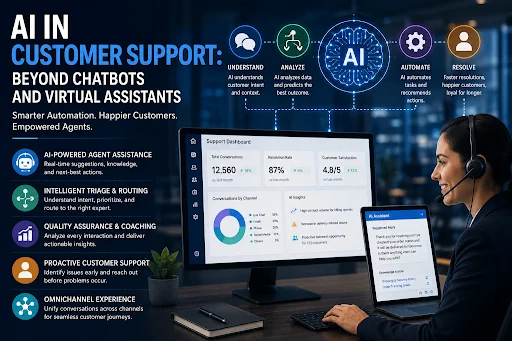
When most business professionals are asked about AI in customer support, they will speak of a chatbot. A small “widget” at the corner of a web page that can respond to FAQs, basic account queries, and automatically escalate to a human when something becomes complicated.
While it may not be a harsh criticism on where most organisations began with AI support, it is a realistic one. Rather than being a harsh critique on where most organisations started with AI support, it’s a realistic one. However, it’s a gross understatement of what’s really going on now.
The chatbot revolution was just the beginning of AI’s impact on customer service, and not the end. What is now happening is much more than that, in terms of the level of sophistication of what the AI can do, and where it can be used in the support function.
But organisations that are only considering AI in support as a deflection tool are not getting the full benefit from the modern AI solution. This is relevant as customer support is one of the most impactful roles in any customer-facing company.
It is the place where relationships are enhanced or impaired. It’s the point at which the difference between what a company promises and delivers becomes apparent. It’s also where operating at scale, without intelligent management, becomes truly unmanageable based upon customer quantity.
The adoption of AI in customer support is not a customer experience exercise for cost saving. It is a capability that affects how an organization can be successful in being able to serve customers at scale without sacrificing the quality of their service.
The Chatbot Ceiling and Why Most Organizations Hit It
The initial phase of AI in customer support went through a logical process. A chatbot was used to deal with the most frequently asked repetitive customer queries. Volume metrics improved. The human agents had more time to deal with the more complicated cases. It was announced a success in implementation.
But then came the restrictions.
Those customers who required assistance with anything other than the scope of the chatbot had painful experiences. Bot-to-Human interactions were frequently poor, and customers ended up repeating data information they already provided.
The lack of intent understanding when users asked the bot in an unusual way led to friction which offset some of the efficiency elsewhere. The system was basically static, without learning capability, did not get better with use, and had to be manually tweaked and kept updated with product and policy developments.
These restrictions do not reflect a lack of the chatbot concept. They represent the intrinsic limit of rule-based conversational AI in a customer support system of such diversity and unpredictability. The ceiling is real, and the majority of organizations that have implemented first generation chatbots have encountered it.
Things that are beyond that ceiling are another level of AI. Not smarter, but AI solutions which integrate into the support operation itself, supporting every facet of the way support works, not just the front-end customer interaction.
AI That Works Alongside Human Agents
Agent assistance is one of the most valuable and underutilized uses of AI in today’s customer service. AI solutions are not a replacement for human agents, but rather a tool that works in tandem with them in real time, enhancing their capabilities and consistency.
AI processes the customer’s input from chat, email or phone and raises relevant information to the attention of the agent before the agent starts drafting a reply. The customer’s history of interactions, open tickets, articles in the knowledge base, and suggested customer scenarios are all displayed automatically in the agent’s interface window, based on the data the AI has analyzed since the customer came online.
AI will track the conversation and adjust its suggestions. When a customer raises a particular issue about a product, the appropriate troubleshooting steps will appear. The conversation is flagged when the AI senses the customer is frustrated, and it is provided with de-escalation guidance. If the agent writes a response, AI can check its accuracy with current policies and make suggestions before sending.
The results are significantly better than those obtained by AI or human agents working alone. Average handling time will be reduced because agents are not looking for information they need. Agents have the entire picture of a customer’s situation from the beginning, thus first contact resolution rates are improved. AI’s ability to always refer to the latest policies and best practices ensures that responses are more consistent as individual agents are not expected to remember everything.
This is AI solutions working as a multiplier on human capability and not as a replacement for it. For support organizations where your agents and their consistency are the main limiting factors for customer experience, it’s a game-changer.
Intelligent Triage and Routing
AI is working before a customer contact sees an agent. Modern AI solutions can analyze incoming contacts on all channels, understand what the contact is asking for, quantify the urgency and complexity of the request, gauge the customer’s likely emotional state and route the contact to the most suitable resource, whether that’s an automation to resolve the request, the right agent team, or a specific account value or issue sensitivity that dictates immediate escalation.
This is not just a rule based routing repackaged as an AI. Advanced triage systems are based on learning from outcomes. They are able to detect trends where first contact resolution is good at some routes and not at others. They evolve over time as products evolve, policies change and as the ratio of incoming contacts changes by season. And they do this continuously, without having to manually update routing logic each time something changes.
Intelligent triage is an operational capability which impacts every downstream metric for large support operations with thousands of contacts every day on various channels and issue types. The faster contacts get to the right resource the better all performance measures of support.
AI-Powered Quality Assurance and Coaching
Customer support’s traditional quality assurance is a sampling process. Only a percentage of interactions are reviewed by QA analysts, who rate their quality based on a rubric and give feedback to agents. This isn’t ideal, but it’s better than nothing. The majority of interactions are not examined. Feedback is delayed. With only a small fraction of interactions visible, patterns that span a large volume can’t be seen.
That’s where AI solutions come in. All interactions can be automatically analyzed, marked with scores against a quality criteria, and flagged for review when the score drops below a threshold or when there are patterns of concern. Unlike sampled interactions, coaches are able to see how all agents are performing on all their interactions. Systemic problems like a particular product problem that is creating a lot of customer confusion become apparent instantly in the pattern data, as opposed to being gradually uncovered over time in samples as they go through QA.
The coaching implications are also great. If an agent is seen as continually failing on a particular interaction type, the coaching can be tailored to that specific interaction type instead of generic. For new agents, AI can give them instant feedback on their interactions instead of reviewing them once a week. The feedback loop becomes tighter and the pace of which the skill is developed increases.
Proactive Support: Getting There Before the Customer Does
One of the most transformative things AI can do for customer support is to take it from reactive to proactive. Traditional support is a reactive model. The customer faces a problem, calls Support, and Support responds. The negative experience has already taken place at the time the interaction takes place.
Proactive support can be achieved at scale through AI solutions leveraging customer data and operational signals. If a pattern of usage data indicates that a customer might face a certain problem, an automated outreach can be sent prior to that problem occurring.
Communication can head off a surge in contacts in the event of a product update that can cause confusion for a certain group of users, depending on their usage. A proactive intervention can occur before a customer decides to leave if their behavior indicates they may be disengaging or at risk of churning.
This severely alters the whole support value proposition. Support shifts from the team who fix the issues when they arise, to the team who prevent the issues from arising. This redefinition impacts on the way in which the function is resourced, how it is assessed, and how it enables business beyond contact volume management.
Omnichannel Consistency Through AI
Today’s customers do not consider the channels they use for moving between the different ones. They may initiate interaction on chat, then email, and if it doesn’t get resolved soon they may call. These contacts are considered to be separate from a main operation in most support operations, and the customer must re-establish context each time.
This friction is eliminated by having a unified history of each customer’s interactions across channels with AI solutions. When a customer calls the agent, he/she sees the entire conversation history. The automated system that replies to an email follow-up will know that it is a follow-up and will respond accordingly, not as it would to a new contact. The customer need not repeat him/herself. They have the sense of a single uninterrupted experience.
For customers, this is a good improvement on the feeling of support. For support, it cuts down on wasted time that is traditionally lost in re-establishing context at the beginning of each interaction.
The Data Flywheel That Makes AI Support Better Over Time
An AI-powered customer support structure has one of its major benefits, and that is its ongoing enhancement over time. Data is created with each interaction. Each resolution outcome represents a message as to what went well and what did not. Each quality rating, each customer satisfaction score, each pattern of escalation, each and every one of these comes back into the AI systems that fuel the routing, triage, and responses.
This forms a data flywheel: the more it processes the more it can process. Organizations with 2-3 years of using AI-powered support operations have systems that have learned from millions of interactions. That learning is a real competitive advantage, a learning that a competitor who starts today can’t learn fast, no matter which tools they select.
This flywheel effect presents an opportunity to consider AI solution adoption timelines for support leaders assessing solutions. The earlier these organizations begin to construct this asset the more the advantage is compounded.
Final Thoughts
The chatbot isn’t for the sake of the chatbot. It was the start of a journey that has evolved in all aspects of how customer support is handled, from triaging contacts, assisting agents, monitoring quality, coaching, and proactively reaching out to customers, to how the organization learns from every customer interaction it encounters.
The companies that have gone beyond chatbots to fully adopt artificial intelligence (AI) for the entire support operation are not only managing more contacts more efficiently, but they are also benefiting in other ways. They are providing a significantly enhanced customer experience, training their talent more quickly, and creating organization-wide intelligence that continually improves based on each interaction.
This isn’t an incremental step over and above the support people have already provided. It’s a different type of what customer service can be. For companies that rely on customer experience to differentiate themselves, it’s clear that grasping the breadth of what AI can do today is a foundational step towards creating a customer support strategy that truly meets modern business demands.