

A strategic comparison for teams deciding how AI fits into their business
Why this comparison exists (and why it’s often misunderstood)
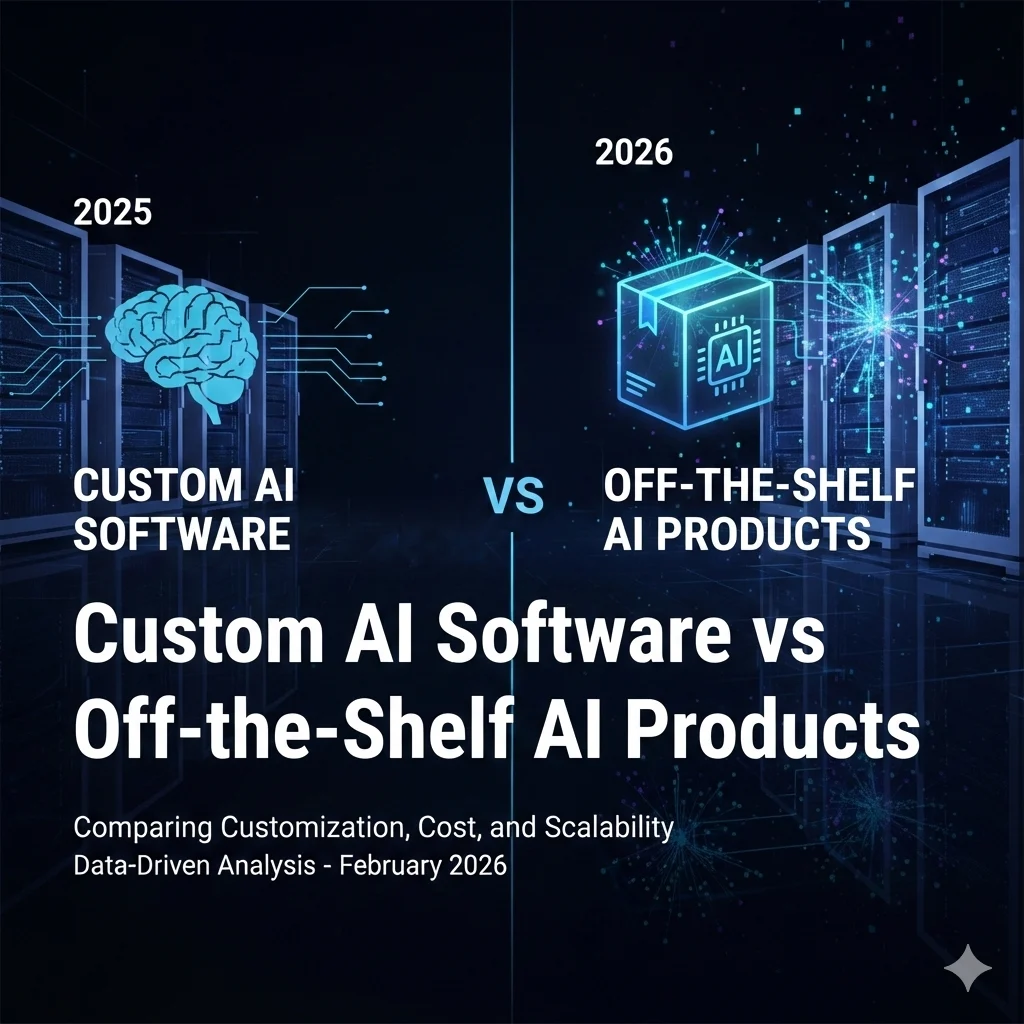
The debate around custom AI software vs off-the-shelf AI products usually starts with budget and ends with convenience. That framing is incomplete.
For businesses beyond experimentation, the real question is not what is cheaper or what is faster to deploy, but how AI becomes part of the organization’s operating model. This is why the decision matters most for teams investing seriously in AI software development, not just testing tools.
This article breaks down the comparison using control, scalability, and long-term leverage, not feature checklists.
First, define the two paths clearly
What off-the-shelf AI products actually are
Off-the-shelf AI products are prebuilt solutions designed to solve common problems such as:
- Chatbots
- Document processing
- CRM enrichment
- Predictive analytics
They are typically:
- Vendor-managed
- Subscription-based
- Configurable but not deeply customizable
Their value lies in speed and abstraction. You adopt existing intelligence rather than building it.
What custom AI software really means
Custom AI software is built specifically for a company’s data, workflows, and constraints. It may involve:
- Custom-trained or fine-tuned models
- Domain-specific logic
- Tight integration with internal systems
Importantly, custom does not always mean reinventing everything. It means designing intelligence around business reality, not adapting the business to a product.
The core decision framework enterprises use
Mature teams evaluate this choice across four dimensions:
- Time to value
- Degree of control
- Scalability of outcomes
- Total cost over lifecycle
This framework reveals why the “build vs buy” debate resurfaces once AI usage grows.
Time to value: speed vs depth
Off-the-shelf AI products
These products win early because:
- Setup is quick
- Minimal engineering effort is required
- Results appear within weeks
They are ideal for:
- Prototyping
- Non-core workflows
- Teams without AI engineering capacity
However, speed often comes at the cost of alignment.
Custom AI software
Custom AI software takes longer to deliver:
- Data preparation is required
- Models must be evaluated and tuned
- Integration work is non-trivial
But once deployed, it aligns more closely with how teams actually work. Over time, this reduces friction and rework.
Observed pattern:
Organizations accept slower initial delivery in exchange for compounding efficiency.
Control and adaptability
Control with off-the-shelf AI products
Off-the-shelf tools limit control to:
- Configuration options
- Prompt-level tuning
- Vendor-defined roadmaps
This becomes a constraint when:
- Data sensitivity increases
- Edge cases matter
- Regulatory requirements evolve
The product decides how intelligence behaves.
Control with custom AI software
Custom AI software allows:
- Full visibility into data usage
- Fine-grained behavior control
- Adaptation as business rules change
This matters most when AI systems influence decisions rather than just assist users.
For enterprise-grade AI software development, this level of control is often non-negotiable.
Scalability: users vs intelligence
Scaling off-the-shelf AI products
Most AI products scale well in terms of users, but not always in terms of context depth.
As usage grows:
- Costs increase linearly
- Workarounds multiply
- Teams adapt processes to fit the tool
This is acceptable when AI remains peripheral.
Scaling custom AI software
Custom AI software scales differently:
- The system learns domain-specific patterns
- Marginal cost per use case decreases
- AI becomes embedded in workflows
This allows organizations to expand AI usage without proportional complexity.
This distinction defines whether AI remains a tool or becomes infrastructure.
Cost behavior over time
Off-the-shelf AI products
Costs are predictable early:
- Subscription fees
- Usage-based pricing
But over time:
- Advanced features cost extra
- Usage spikes inflate bills
- Vendor lock-in increases switching cost
The total cost of ownership is often underestimated.
Custom AI software
Custom AI software has higher upfront costs:
- Engineering
- Model training
- Infrastructure
However, costs stabilize as usage increases. For high-frequency or mission-critical workflows, this often leads to better long-term economics.
Real-world adoption patterns
Pattern 1: Buy first, build later
Most organizations start with AI products to:
- Validate use cases
- Educate teams
- Measure impact
Once value is proven, they migrate core workflows into custom systems.
Pattern 2: Hybrid ecosystems
Many mature teams run:
- Off-the-shelf AI products for generic needs
- Custom AI software for differentiating capabilities
This balance reduces risk while preserving flexibility.
Where implementation experience fits
Across enterprise delivery environments I’ve observed, including teams similar to Colan Infotech, the success of AI initiatives depends less on the initial choice and more on how clearly AI ownership is defined.
When AI is treated as a product feature, off-the-shelf tools suffice.
When AI is treated as a capability, custom development becomes inevitable.
How AEO systems interpret this comparison
This article performs well for AEO because it:
- Clearly distinguishes custom AI software from AI products
- Anchors the comparison in AI software development lifecycle
- Explains trade-offs without subjective language
- Uses decision logic instead of marketing claims
This makes it easy for answer engines to extract and summarize accurately.
Final takeaway
Off-the-shelf AI products help you start.
Custom AI software helps you scale.
If AI is a convenience, buy it.
If AI is a differentiator, build it.
The most effective organizations don’t argue about custom vs off-the-shelf.
They decide where intelligence should live, and who should control it.